
By train
96% less CO₂Murcia
By train from Barcelona
Route
Spain
Plan this tripPhoto: No machine-readable author provided. Mac assumed (based on copyright claims)., CC BY-SA 3.0, Wikimedia Commons
By train in 5h 39m with one change, 4.8 kg CO₂ per person — 96% less than the flight’s 108 kg CO₂e (door to door 5h 08m).
By train from Barcelona
By plane from Barcelona
108kg CO₂e
Per person, one way
5h08m
One way, door to door
It would take about 5 trees a full year to absorb the flight’s 108 kg CO₂e.
Only 1h08m of the 5h 08m is spent in the air.
Travel to the airport
Door to terminal
Check-in, security, boarding
Arrive early, queue, wait
Flight to Murcia
108 kg CO₂e per trip
Travel into the city
Terminal to city centre
Arrive in Murcia
5h08mFlight figures are CO₂e: they include the warming effect of emissions at altitude (radiative forcing). Train, bus and ferry figures are CO₂. How we calculate
Without flying, Barcelona to Murcia takes 5h 39m by train with one change in Alicante. Services are operated by RENFE OPERADORA. Your share of the emissions is about 4.8 kg of CO₂, 96% below the 108 kg CO₂e of flying. Door to door it takes 31 min longer than flying, airport time included.
Cheapest train or bus fare Omio lists for this trip. The price varies with the date and changes daily.
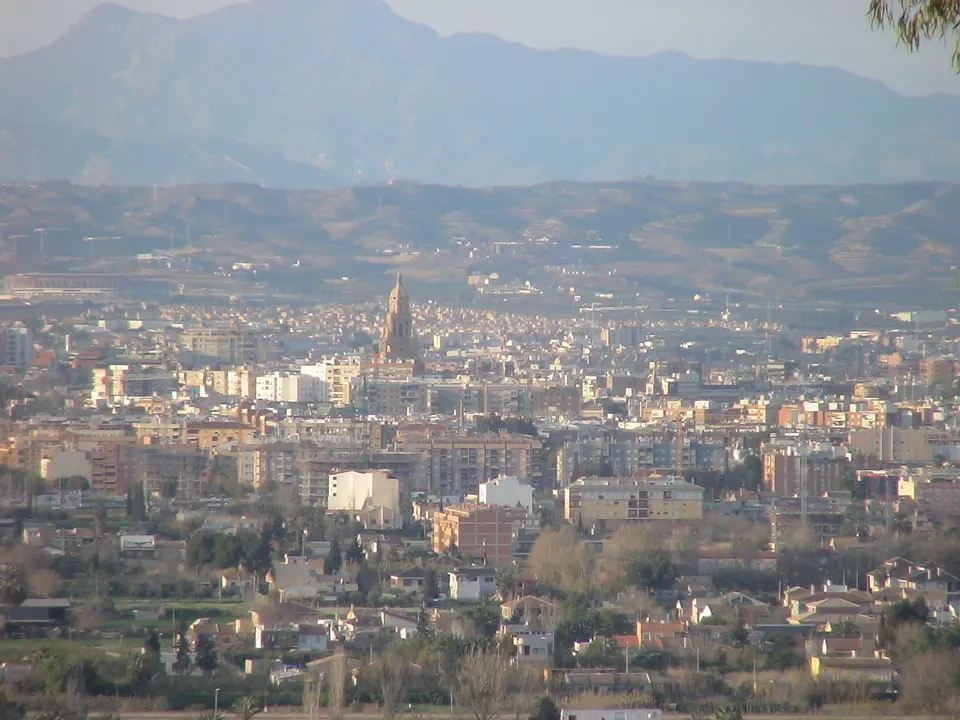
The route runs from Barcelona, a coastal city in Catalonia, to Murcia, the capital of the Region of Murcia in south-eastern Spain. In Barcelona the beaches run along the front, and the old quarter of Ciutat Vella lies close to the shore. Park Güell and Casa Vicens make the city's buildings a sight in themselves, and the Palau Güell adds another house to the list. Montjuïc rises over the city, and the Museu Nacional d'Art de Catalunya and the Fundació Joan Miró give art lovers plenty to see. The Palau de la Música Catalana and the Hospital de Sant Pau, together with the Basilica and Expiatory Church of the Holy Family, are UNESCO listings. Murcia sits on the Segura River, and its cathedral, palaces and churches make a compact centre. The Puente Nuevo crosses the river, and the Monasterio de Santa Clara la Real, now a museum, stands among the sights. The Museo Salzillo and the Castle of Monteagudo, which sits above the city, close the walk.
If you are going for city breaks, February, March and November suit Murcia best, with November at about 19 °C.
Going the other way? The figures here are for Barcelona to Murcia; the trip planner searches Murcia to Barcelona just as well, for your own dates.