
By train
78% less CO₂Copenhagen
By train from Berlin
10kg CO₂
Per person, one way
6h39m
One way, by train
The route
train with DB Fernverkehr AG1h 49m
train with DSB/DB4h 30m
Route
Germany → Denmark
Plan this tripPhoto: Pudelek, CC BY-SA 4.0, Wikimedia Commons
By train in 6h 39m with one change, 10 kg CO₂ per person — 78% less than the flight’s 45 kg CO₂e (door to door 4h 59m).
By train from Berlin
10kg CO₂
Per person, one way
6h39m
One way, by train
train with DB Fernverkehr AG1h 49m
train with DSB/DB4h 30m
By plane from Berlin
45kg CO₂e
Per person, one way
4h59m
One way, door to door
It would take about 2 trees a full year to absorb the flight’s 45 kg CO₂e.
Only 59m of the 4h 59m is spent in the air.
Travel to the airport
Door to terminal
Check-in, security, boarding
Arrive early, queue, wait
Flight to Copenhagen
45 kg CO₂e per trip
Travel into the city
Terminal to city centre
Arrive in Copenhagen
4h59mFlight figures are CO₂e: they include the warming effect of emissions at altitude (radiative forcing). Train, bus and ferry figures are CO₂. How we calculate
10h12m · 3.5 kg CO₂
train with Snälltåget9h 19m
train with Öresundståg33 min
Without flying, Berlin to Copenhagen takes 6h 39m by train with one change in Hamburg. Services are operated by DB Fernverkehr AG and DSB/DB. Your share of the emissions is about 10 kg of CO₂, 78% below the 45 kg CO₂e of flying. Door to door it takes 1h 40m longer than flying, airport time included.
Cheapest train or bus fare Omio lists for this trip. The price varies with the date and changes daily.
Yes. A night option from Berlin to Copenhagen takes 10h 12m with Snälltåget and Öresundståg. It emits about 3.5 kg of CO₂ per person. It takes 3h 33m longer than the day option, with much of the trip overnight.
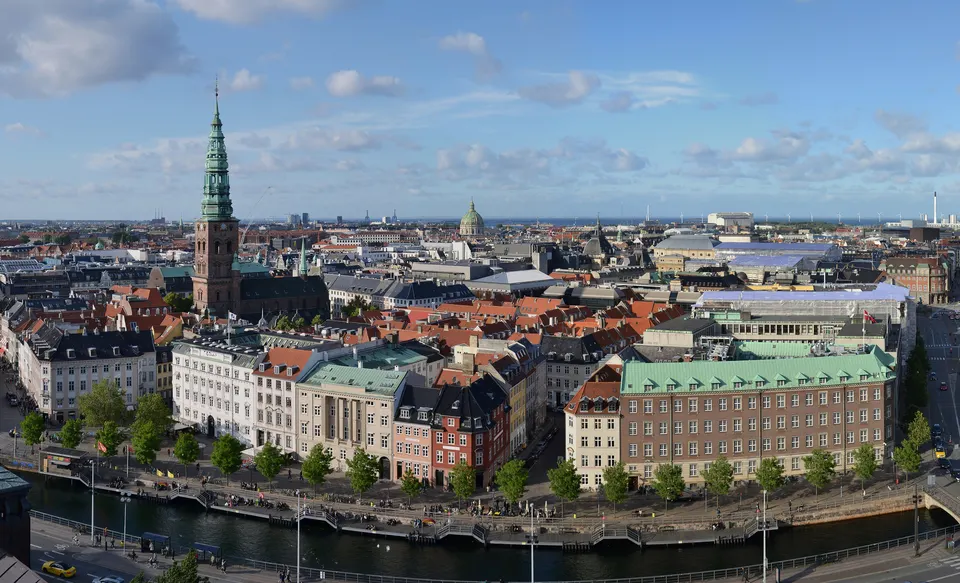
Copenhagen is known for its museums: the Nationalmuseet, the Ny Carlsberg Glyptotek and the Thorvaldsens Museum all sit in the city's centre. The Vor Frue Kirke and the Frederiksberg Slot add a church and a palace, and the Dansk Arkitektur Center covers the city's buildings. Copenhagen is the capital and largest city of Denmark, mostly on the island of Zealand. Coming from Berlin, a German capital of museums and a museum island, you travel through Hamburg and arrive on Zealand, where the Øresund Bridge links the city to Sweden by rail and road. The change is from a German capital of modernist estates to a Danish one with a sea edge and a stronger grip on its old quarters.
If you are going for city breaks, June, July and August suit Copenhagen best, with June at about 18 °C.
Going the other way? The figures here are for Berlin to Copenhagen; the trip planner searches Copenhagen to Berlin just as well, for your own dates.