
By train
85% less CO₂Linz
By train from Erfurt
Route
Germany → Austria
Plan this tripPhoto: Kani, CC BY-SA 4.0, Wikimedia Commons
By train in 4h 49m with 2 changes, 7.3 kg CO₂ per person — 85% less than the flight’s 48 kg CO₂e (door to door 5h 01m).
By train from Erfurt
By plane from Erfurt
48kg CO₂e
Per person, one way
5h01m
One way, door to door
It would take about 2 trees a full year to absorb the flight’s 48 kg CO₂e.
Only 1h01m of the 5h 01m is spent in the air.
Travel to the airport
Door to terminal
Check-in, security, boarding
Arrive early, queue, wait
Flight to Linz
48 kg CO₂e per trip
Travel into the city
Terminal to city centre
Arrive in Linz
5h01mFlight figures are CO₂e: they include the warming effect of emissions at altitude (radiative forcing). Train, bus and ferry figures are CO₂. How we calculate
The best way from Erfurt to Linz without flying takes 4h 49m by train, with 2 changes, in Nuremberg and Passau. The trip is run by DB Fernverkehr AG, OEBB Personenverkehr AG Kundenservice and ÖBB. Per person, the trip produces about 7.3 kg of CO₂ against 48 kg CO₂e by air, a saving of 85%. Door to door, the flight is actually 12 min slower.
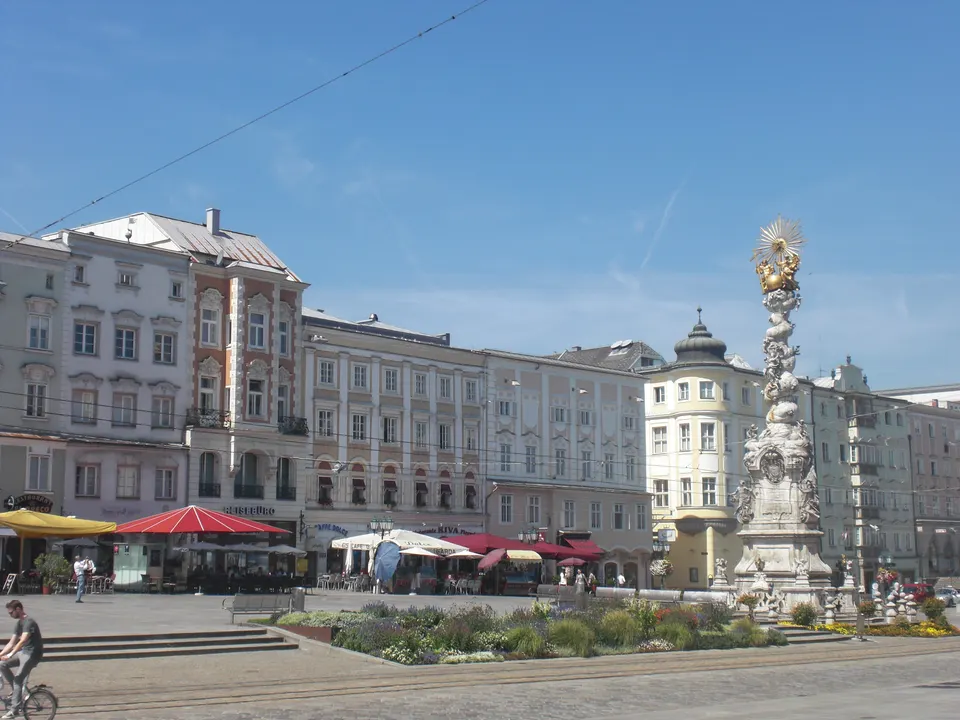
Linz sits on the Danube in the far north of Austria, and its setting is a river city with hills at its edge. The Pöstlingberg rises above the town, and the Lentos Art Museum and the Ars Electronica Center stand in the centre. Coming from Erfurt, a Thuringian city of churches set in the valley of the River Gera, you travel south into Austria and arrive in an Upper Austria capital of two cathedrals and a modern art museum, where the trip is one of river views and galleries rather than of gardens and churches alone.
Plan city breaks in Linz for April, May and September, when September reaches about 19 °C.
Going the other way? The figures here are for Erfurt to Linz; the trip planner searches Linz to Erfurt just as well, for your own dates.