
By train
86% less CO₂Mannheim
By train from Utrecht
Route
Netherlands → Germany
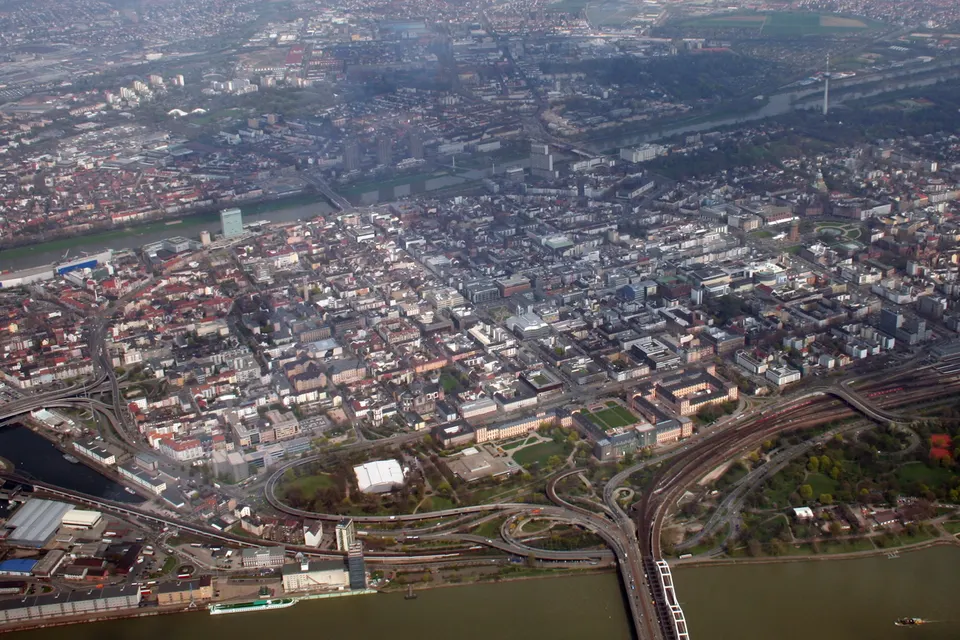
Plan this tripPhoto: Dominik Lott ( Dolo280 ), CC BY-SA 2.5, Wikimedia Commons
By train in 4h 30m with one change, 6.6 kg CO₂ per person — 86% less than the flight’s 48 kg CO₂e (door to door 5h 00m).
By train from Utrecht
By plane from Utrecht
48kg CO₂e
Per person, one way
5h00m
One way, door to door
It would take about 2 trees a full year to absorb the flight’s 48 kg CO₂e.
Only 1h00m of the 5h 00m is spent in the air.
Travel to the airport
Door to terminal
Check-in, security, boarding
Arrive early, queue, wait
Flight to Mannheim
48 kg CO₂e per trip
Travel into the city
Terminal to city centre
Arrive in Mannheim
5h00mFlight figures are CO₂e: they include the warming effect of emissions at altitude (radiative forcing). Train, bus and ferry figures are CO₂. How we calculate
Allow 4h 30m to get from Utrecht to Mannheim by train, with one change in Cologne. Services are operated by NS Int and DB Fernverkehr AG. Your share of the emissions is about 6.6 kg of CO₂, 86% below the 48 kg CO₂e of flying. Door to door, it is 30 min quicker than flying once airport time is counted.
Mannheim is a city of palaces and museums at the centre of the Rhine-Neckar region, the hub of the area's culture and business. The Mannheim Palace, the Kunsthalle Mannheim and the Jesuit Church are among its main sights, and the Angel of Peace and Christ Church add to the centre. From Utrecht, a Dutch city that holds the Rietveld Schröder House as a UNESCO site and the Centraal Museum in its centre, you cross the German border on the way east. The change is from Dutch museums to a German palace city, and the Luisenpark gives Mannheim its green side.
If you are going for city breaks, April, May and September suit Mannheim best, with May at about 19 °C.
Going the other way? The figures here are for Utrecht to Mannheim; the trip planner searches Mannheim to Utrecht just as well, for your own dates.