
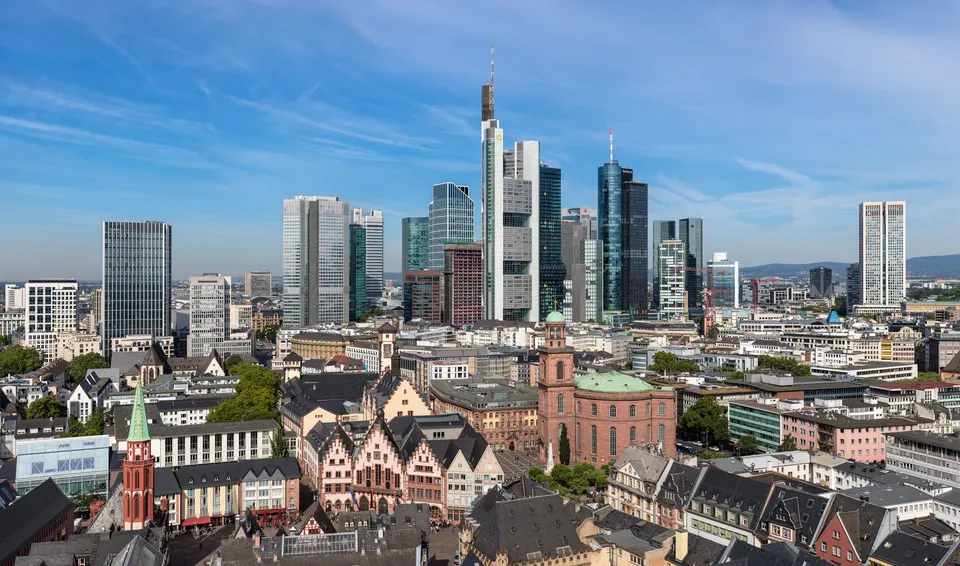
By train
89% less CO₂Frankfurt
By train from Vienna
Route
Austria → Germany
Plan this tripPhoto: Thomas Wolf , www.foto-tw.de, CC BY-SA 3.0 de, Wikimedia Commons
By train in 6h 30m with no changes, 8 kg CO₂ per person — 89% less than the flight’s 76 kg CO₂e (door to door 5h 19m).
By train from Vienna
By plane from Vienna
76kg CO₂e
Per person, one way
5h19m
One way, door to door
It would take about 3 trees a full year to absorb the flight’s 76 kg CO₂e.
Only 1h19m of the 5h 19m is spent in the air.
Travel to the airport
Door to terminal
Check-in, security, boarding
Arrive early, queue, wait
Flight to Frankfurt
76 kg CO₂e per trip
Travel into the city
Terminal to city centre
Arrive in Frankfurt
5h19mFlight figures are CO₂e: they include the warming effect of emissions at altitude (radiative forcing). Train, bus and ferry figures are CO₂. How we calculate
Without flying, Vienna to Frankfurt takes 6h 30m by train with no changes. You travel with DB/ÖBB. That emits about 8 kg of CO₂ per person, 89% less than the flight's 76 kg CO₂e. Against the flight's door-to-door time, you spend 1h 11m more on the way.
Cheapest train or bus fare Omio lists for this trip. The price varies with the date and changes daily.
Vienna is known for its palaces and museums, with the Hofburg Palace, the Belvedere and the Albertina forming a historic centre listed by UNESCO. The trip runs west toward Frankfurt, a city on the Main in Hesse, where the Frankfurt Cathedral, the Städel Museum and the Goethe House are the sights to plan around. Frankfurt is a river city, and its old quarter gives a different sense of time from the imperial avenues of Vienna. The Goethe House and the Altstadt make a fine finish to the day. It suits a city and culture trip across Austria and Germany.
Frankfurt is at its best for city breaks in May, June and September; May averages 19 °C.
Going the other way? The figures here are for Vienna to Frankfurt; the trip planner searches Frankfurt to Vienna just as well, for your own dates.