By Thomas AxelssonPublished Updated 4 min read
Vienna to Milan is a long day on the train with one change, and most of the planning is about that change and whether you want to ride overnight. For times, changes and CO₂ against the flight, see the Vienna to Milan route guide.
Where is the change on the Vienna to Milan train?
The change is in Venice. You ride from Vienna to Venice first, then take a second train on to Milan. The route data lists no direct service for this pair.
Two operators share the work. ÖBB Railjet runs Vienna to Venice, which takes 7h 30m, and Trenitalia runs Venice to Milan, which takes 2h 30m. The first leg is the long one, so the change comes late in the day. Leave a comfortable gap in Venice before the second train, because a late arrival from Vienna is the one thing that can cost you the connection. Check the departures for both legs before you commit.
Is there a night option?
Yes. The route data lists a night option that takes 12h 20m, which is 2h 00m longer than the daytime trip, and it uses the same two operators, ÖBB Railjet and Trenitalia. It emits 15 kg of CO₂.
The longer figure suggests a different shape of trip: you travel through the evening and arrive later, which may suit you if you want to keep your working day in Vienna. The data holds no detail on the night service, such as berths or boarding times, so check the details for your date before you rely on it.
Is the train practical compared with flying?
Not on time. The flight takes 5h 20m door to door once airport time is added, and the train is 300 minutes behind it. That is a large gap, and it is the honest reason to think about the trip as a day of travel rather than a quick hop.
The case for the train is the footprint and the way you spend the time. It emits 13 kg of CO₂ against 80 kg for the flight, a saving of 67 kg or 84%. If you can spare the day, Venice is a stop on the way and not just a change, so you pass through a city you could look at if the gap allows.
When is the best time to visit Milan?
April comes first for a City & Culture trip, with an average daily high of 17 °C. October follows, then May, March and September. If you prefer warmth, July is the warmest month at 29 °C and August follows at 28 °C. January and December are the coldest, at 7 °C.
| Month | average high |
|---|---|
| January | 7 °C |
| February | 9 °C |
| March | 14 °C |
| April | 17 °C |
| May | 22 °C |
| June | 26 °C |
| July | 29 °C |
| August | 28 °C |
| September | 23 °C |
| October | 17 °C |
| November | 11 °C |
| December | 7 °C |
Vienna is cooler in winter, with 3 °C in January, so Milan is the milder end of the trip at that time. In summer Vienna reaches 26 °C in July against 29 °C in Milan. For a spring trip, see the ideas page for a city break in April.
What is there to see in Milan?
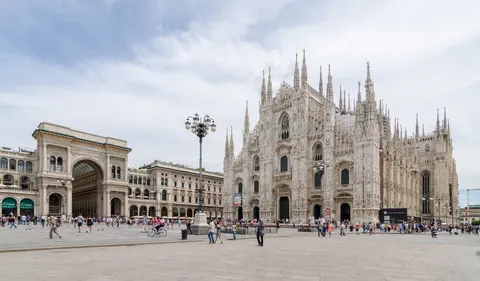
The list is led by churches, castles and galleries. Milan Cathedral, Sforza Castle, the Pinacoteca di Brera, the Basilica of Sant'Ambrogio, the Royal Palace of Milan and the Museo Poldi Pezzoli are the sights in the data. Santa Maria delle Grazie is a UNESCO site 1.5 km from the centre.
After a ride of 10h 20m, you will probably want an easy first evening. Pick one landmark close to where you are staying and leave the rest for the next day. Monza is 15 km from Milan, Como 39 km, Novara 44 km and Bergamo 46 km, all within day-trip distance on paper, though the route data has no rail times for them.
How should you split the day?
Because the first leg takes 7h 30m, think of the trip as two blocks. The long block is Vienna to Venice, and the short one is Venice to Milan at 2h 30m. A morning start from Vienna puts the change in the afternoon and the arrival in Milan in the evening. A night departure flips that, and by the time you reach the change it is already late in the trip.
Whichever you choose, fix the Venice change first and fit the rest around it. The reverse trip uses the same legs in the other order, with the short Trenitalia ride first and the long ÖBB Railjet leg after it.
What can you see in Vienna before you leave?
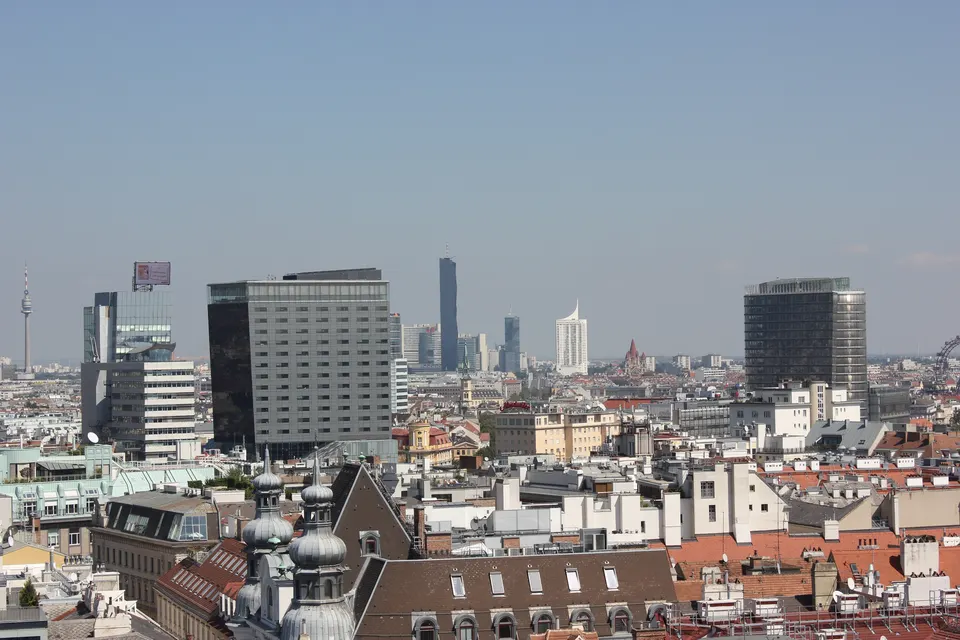
If you depart in the morning you may not have time, but a late departure leaves one. The Belvedere, St. Stephen's Cathedral and the Hofburg Palace are the landmarks. Vienna lists two UNESCO sites: the Historic Centre of Vienna, 0.1 km from the centre, and the Palace and gardens of Schönbrunn, 5.1 km away.
Where can you go on from Milan?
Milan is a rail hub with 17 direct links by train. It reaches 978 destinations within eight hours and 2,261 within fourteen. Vienna has 45 direct links and reaches 814 within eight hours and 2,311 within fourteen.
From Milan these onward trains are in the data:
- Bologna takes 1h 00m.
- Verona takes 1h 12m.
- Turin takes 1h 28m, run by SNCF VOYAGEURS.
- Florence takes 1h 48m.
- Venice takes 2h 30m.
- Rome takes 3h 00m.
For longer trips that end in Milan, the route guides cover Paris to Milan, London to Milan, Berlin to Milan and Rome to Milan.