
Milan is the capital of the Lombardy region in northern Italy and the second-largest city in the country after Rome. It sits in the flat Po Valley, with the Alps and the great lakes Como, Maggiore and Lugano to the north. Milan is Italy's economic capital, and its metropolitan area is the largest in the country. It is also a centre of fashion, design and art.
With about 1.4 million inhabitants, Milan lies in Lombardy, Italy, and is a rail hub.
Why go to Milan?
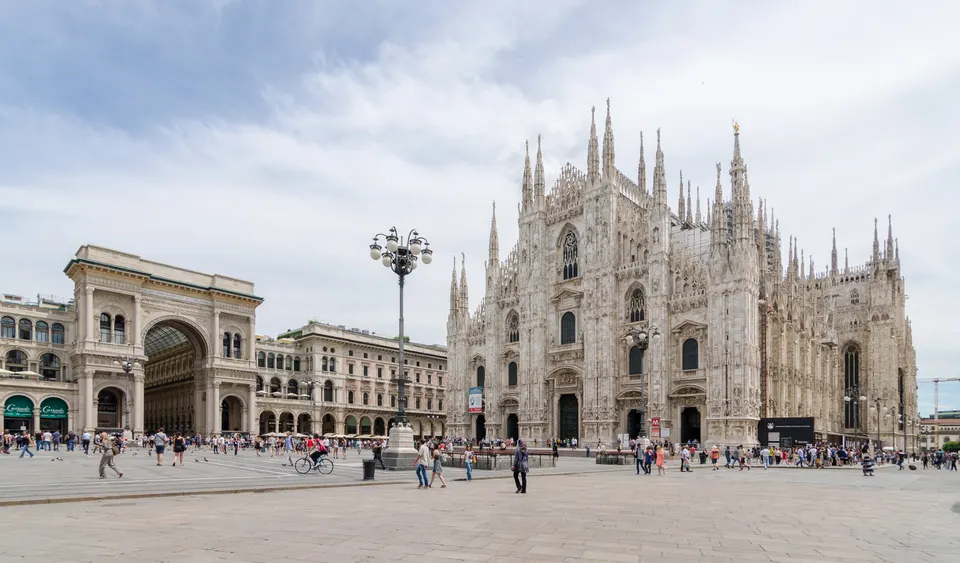
Milan's architecture spans many periods. The Duomo, Italy's largest church and the most important Gothic building in the country, took centuries to finish, and its gilt bronze statue of the Virgin Mary has become a symbol of the city. The Castello Sforzesco began as a Visconti fortress and became a Renaissance court in the 15th century, set in a walled hunting park. Teatro alla Scala opened during the renewal under Empress Maria Theresa of Austria, and the Galleria Vittorio Emanuele II is a covered passage with a glass and cast-iron roof. Milan is also a fashion capital, with museums and galleries that hold major works by Leonardo da Vinci.
When is the best time to visit Milan?
Average highs range from 7 °C in January and December to 29 °C in July. For city breaks, any month of the year works.
How do I get to Milan without flying?
Direct train services link Milan with 17 destinations. Allowing for changes, 2,261 destinations are no more than 14 hours away without flying. Rome is 3h 00m away by train with Trenitalia, with about 4 kg of CO₂ per person against 109 kg for the flight, 96% less. The train from Venice with Trenitalia takes 2h 30m; that is about 3 kg of CO₂ per person, 95% less than the 56 kg of a flight. From Florence, it takes 1h 48m by train with Trenitalia, with about 2 kg of CO₂ per person against 57 kg for the flight, 96% less.
What to do in Milan
Milan's Cathedral
The largest church in Italy and the most important Gothic building in the country, with a gilt bronze Virgin Mary on its highest pinnacle.
Castello Sforzesco
A Renaissance court built from an old Visconti fortress, set in a walled hunting park.
Galleria Vittorio Emanuele II
A covered passage with a glass and cast-iron roof, inspired by the Burlington Arcade in London.
Teatro alla Scala
The opera house, opened during the renewal under Empress Maria Theresa of Austria.