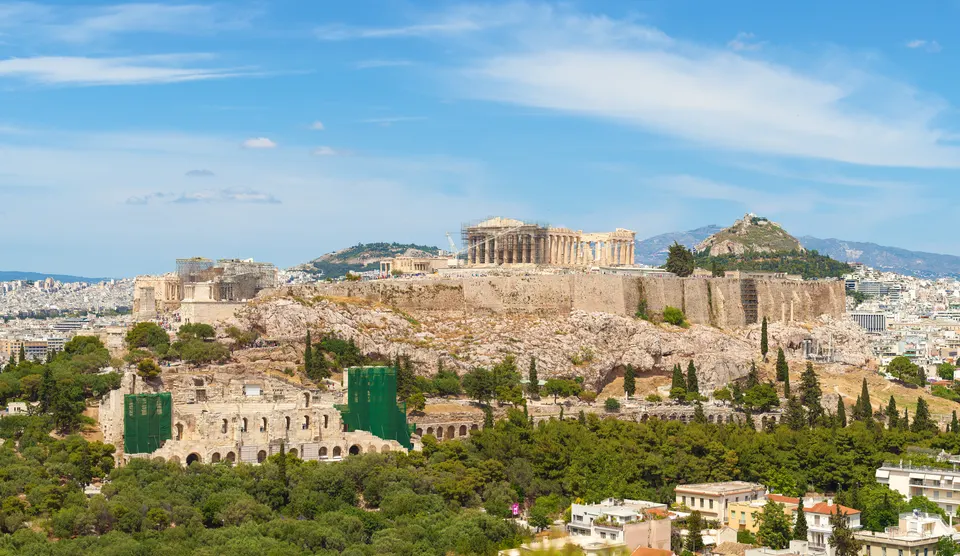

Athens is the capital and largest city of Greece, spread across the central plain of Attica between four mountains. Its recorded history spans more than 3,400 years, and in classical times it was one of the most powerful city-states in ancient Greece. The Parthenon and the Acropolis, a UNESCO World Heritage Site, remain key landmarks of early Western culture. Today it is a cosmopolitan metropolis, with a large financial sector and the port of Piraeus nearby.
About 664,000 people live in Athens, in Attica, Greece, and its station is a rail hub.
Why go to Athens?
Athens is a city of museums and archaeology. The National Archaeological Museum holds the world's largest collection of ancient Greek antiquities, and the Acropolis Museum, opened in 2009, replaces an older museum on the Acropolis. The Goulandris Museum of Cycladic Art is home to figurines of white marble, and the Benaki Museum covers ancient, Byzantine, Ottoman-era and Chinese art. The Kerameikos burial site shows how Athenians viewed death across the ages. Neoclassical buildings such as the Zappeion Hall and the Athens Academy still stand in the city.
When is the best time to visit Athens?
Expect daytime highs of about 33 °C in July and August, falling to 12 °C in January and February. If you are after city breaks, aim for March, April and November.
How do I get to Athens without flying?
You can get to Athens without changing from 14 destinations, by bus/ferry, ferry or train. With changes, Athens is within 14 hours of 182 destinations without flying. From Kos, it takes 10h 00m by ferry with Blue Star, with about 15 kg of CO₂ per person against 77 kg for the flight, 81% less. Travelling from Thessaloniki, allow 4h 30m by train with Hellenic Train; that is about 6 kg of CO₂ per person, 91% less than the 69 kg of a flight. Mykonos is 3h 00m away by ferry with Blue Star / SeaJets, with about 10 kg of CO₂ per person against 35 kg for the flight, 71% less.
What to do in Athens
Acropolis of Athens
A UNESCO World Heritage Site and the city's classical heart, home to the Parthenon, a key landmark of early Western culture.
National Archaeological Museum
The country's largest archaeological museum, with artefacts covering more than 5,000 years, from the late Neolithic to Roman Greece.
Benaki Museum
A museum with several branches, one for each of its collections, from ancient and Byzantine to Ottoman-era and Chinese art.
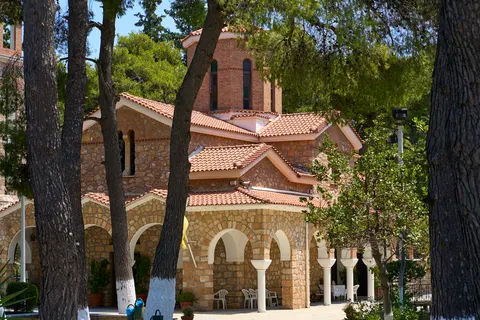
Daphni Monastery
A medieval monastery and the second of Athens' two UNESCO World Heritage Sites.