
Budapest is the political, economic and cultural centre of Hungary, and its character comes from the Danube that runs through it. The city stands in the Pannonian Basin, where ancient trade routes linked the hills of Transdanubia with the Great Plain. Its UNESCO listing covers the Danube banks, Buda Castle and Andrássy út, which shows how much the river and the old quarters matter.
Budapest, in Hungary, is home to about 1.7 million people and works as a rail hub.
Why go to Budapest?
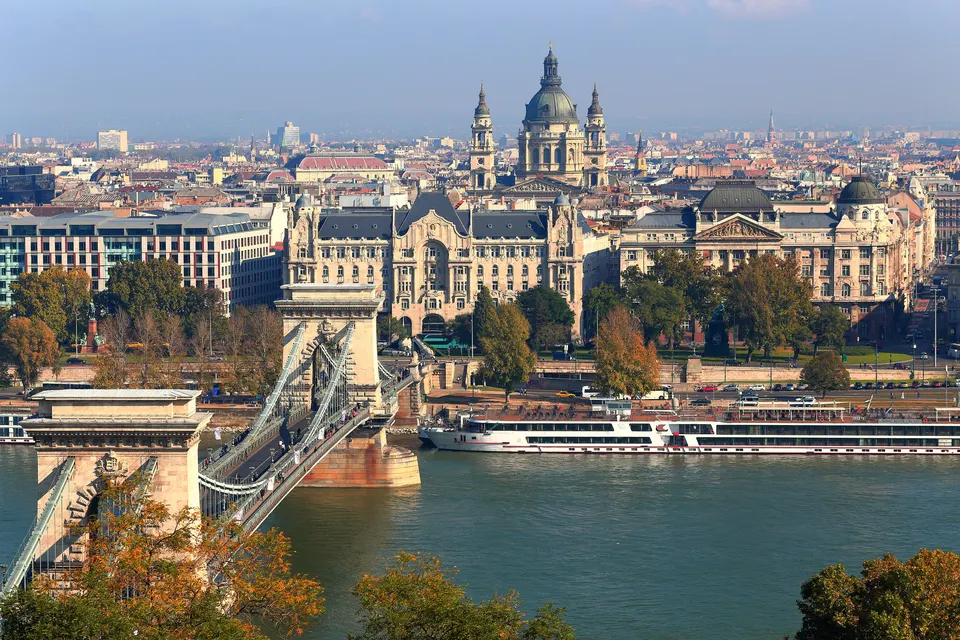
Begin at Buda Castle, then walk down to the Széchenyi Chain Bridge, one of the bridges that cross the Danube. Matthias Church and St. Stephen's Basilica are two of the city's main churches. The Hungarian National Museum and the Museum of Fine Arts, Budapest give the city's history and art a serious home, and the House of Terror Museum is a sober stop. Andrássy út is UNESCO-listed too, so it makes a good walk between the museums. Liberty Bridge and Elisabeth Bridge add more crossings of the river, and each gives a different view of the water. The castle area is worth a slow walk.
When is the best time to visit Budapest?
In July and August the average high reaches 26 °C; in January it is closer to 2 °C. For city breaks, go in April, May and September.
How do I get to Budapest without flying?
Budapest has direct bus or train links to 15 destinations. Within 14 hours, travellers from 1,774 destinations can get here without flying. The train from Vienna with ÖBB/MAV takes 2h 30m; that is about 3 kg of CO₂ per person, 89% less than the 27 kg of a flight. Belgrade is 8h 00m away by train with SV/MAV, with about 10 kg of CO₂ per person against 41 kg for the flight, 76% less. Travelling from Bucharest, allow 15h 00m by train with CFR/MAV; that is about 20 kg of CO₂ per person, 76% less than the 82 kg of a flight.
What to do in Budapest
Buda Castle
Visit Buda Castle, a UNESCO-listed site above the river, and walk around the old quarter that gives the castle its setting.
Széchenyi Chain Bridge
Cross the Széchenyi Chain Bridge on foot for a walk over the Danube, moving between the two banks of the river.
St. Stephen's Basilica
Step into St. Stephen's Basilica, one of the main churches of the city, and set aside time for the wider area around it.
Andrássy út
Walk the Andrássy út at an unhurried pace, since it is UNESCO-listed, and visit the Museum of Fine Arts, Budapest for a break from the streets.
Hungarian National Museum
Give the Hungarian National Museum a morning to tell the country's story, and balance it with a visit to the House of Terror Museum, a serious stop.