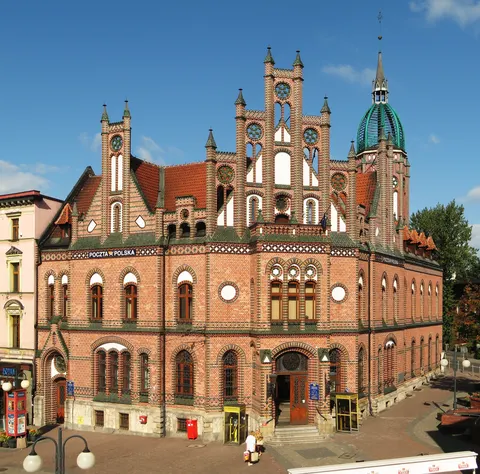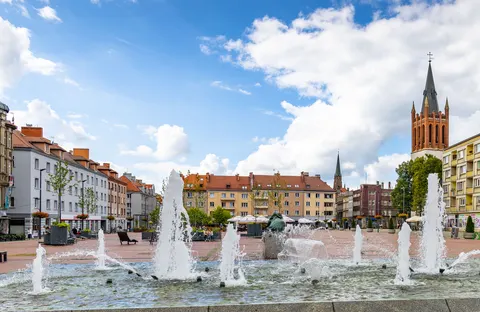

Dąbrowa Górnicza is a city in southern Poland, in the eastern part of the Katowice urban area in the Silesian Voivodeship. It lies on the Czarna Przemsza and Biała Przemsza rivers and gives its name to the Dąbrowa Basin. With about 117,000 inhabitants, it is the second largest city in the basin after neighbouring Sosnowiec.
Dąbrowa Górnicza is in Silesia, Poland, and has a population of about 117,000; it is also a rail hub.
Why go to Dąbrowa Górnicza?
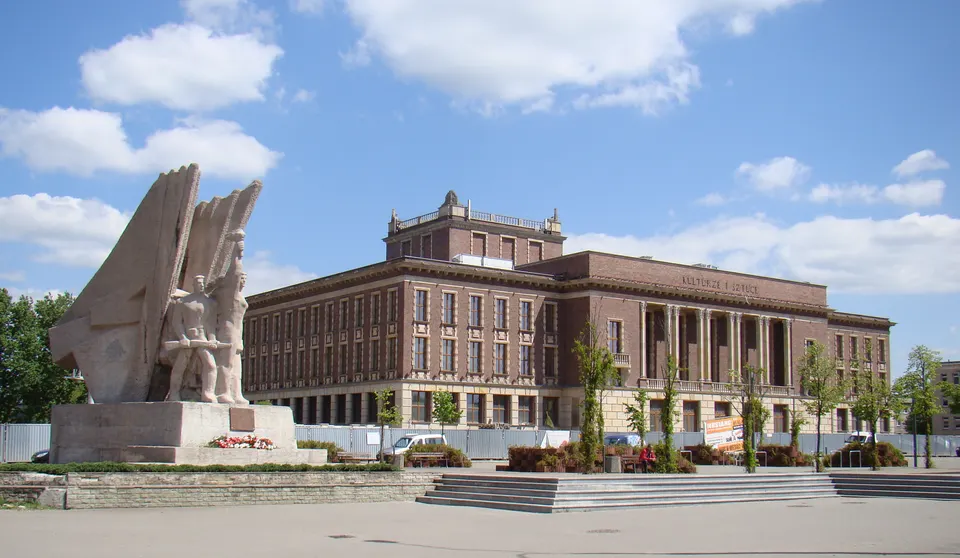
The Dąbrowa Basin is an industrial and historical subregion, and the city sits at its heart. In 1968 the local church of Saint Mary of the Angels was visited by Primate Stefan Wyszyński and Cardinal Karol Wojtyła, the future Pope John Paul II. The Katowice Steelworks, built in the 1970s, is now the biggest steel producing plant in Poland. The city's cultural life includes the Palace of Zagłębie Culture, the City Museum Sztygarka and the Film Center Helios. The oldest part of the town, Reden, still exists.
When is the best time to visit Dąbrowa Górnicza?
July and August are the warmest, with highs of about 23 °C, and January is the coolest, at about 0 °C.
How do I get to Dąbrowa Górnicza without flying?
From 4 destinations you can travel to Dąbrowa Górnicza directly by train. Counting connections, 1,482 destinations can reach it within 14 hours without flying. Travelling from Sosnowiec, allow 7 min by train with PKP Intercity; that is about 0.3 kg of CO₂ per person. From Zawiercie, it takes 15 min by train with PKP Intercity, with about 0.7 kg of CO₂ per person. The train from Będzin with Koleje Śląskie takes 3 min; that is about 0.2 kg of CO₂ per person.
What to do in Dąbrowa Górnicza
Church of Saint Mary of the Angels
The local church visited in 1968 by Primate Stefan Wyszyński and Cardinal Karol Wojtyła.
Palace of Zagłębie Culture
One of the city's main cultural institutions, alongside the City Museum Sztygarka.
Reden
The oldest part of the town, which still stands.