
Dessau is a district of Dessau-Roßlau in Saxony-Anhalt, eastern Germany, where the rivers Mulde and Elbe meet. It was an independent city until 2007. The town lies on a floodplain and is surrounded by parks and palaces, which makes it one of the greenest towns in Germany. The wooded Mosigkauer Heide touches its southern edge.
With about 68,000 inhabitants, Dessau lies in Saxony-Anhalt, Germany, and is a rail hub.
Why go to Dessau?
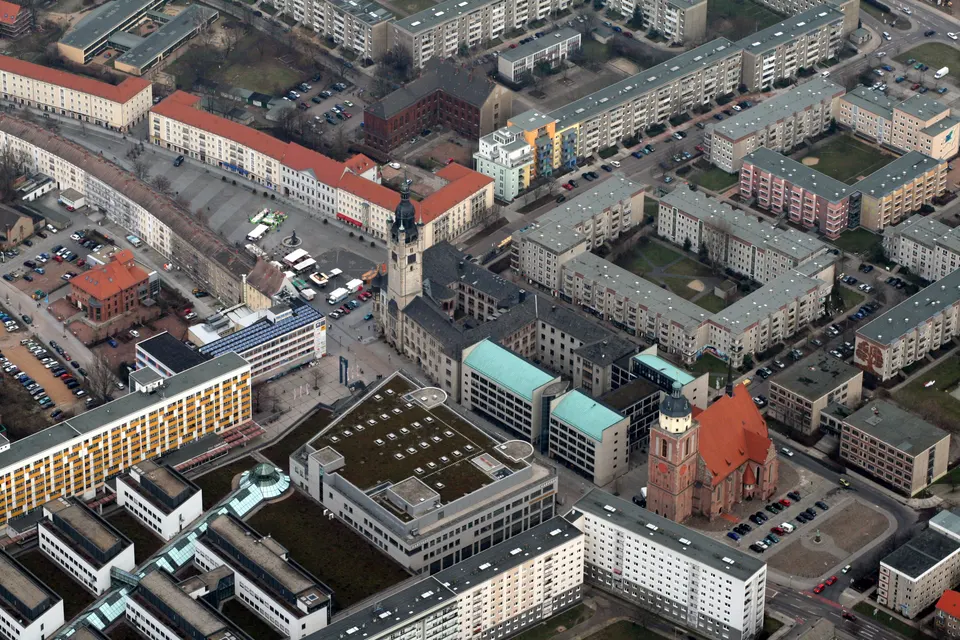
Dessau is best known as the second home of the Bauhaus school. It moved here after closing in Weimar, and artists including Walter Gropius, Paul Klee and Wassily Kandinsky taught here before the Nazi-controlled city council forced its closure. The town was heavily bombed in the Second World War and rebuilt in GDR concrete slab style, but many of its historic buildings have been restored since reunification. Parks and palaces ring the town, among them Luisium Castle, Mosigkau Palace and Oranienbaum Palace. The composer Kurt Weill was born here, and an annual Kurt Weill Festival is held in his name.
When is the best time to visit Dessau?
Average highs range from 3 °C in January to 24 °C in July. May, June and September are the time for city breaks.
How do I get to Dessau without flying?
Direct train services link Dessau with 3 destinations. Allowing for changes, 2,328 destinations are no more than 14 hours away without flying. Leipzig is 38 min away by train with DB Regio AG Südost, with about 1 kg of CO₂ per person. The train from Halle with DB Regio AG Südost takes 50 min; that is about 0.8 kg of CO₂ per person. From Magdeburg, it takes 45 min by train with DB Regio AG Südost, with about 0.9 kg of CO₂ per person.
What to do in Dessau
Luisium Castle
A castle with a museum and its own park, one of the palaces that ring the town.
Mosigkau Palace
A palace with a museum, set among the wooded area south of the town.
Oranienbaum Palace
A palace with a museum and a park.
Hugo Junkers Technical Museum
A technical museum named after Hugo Junkers.