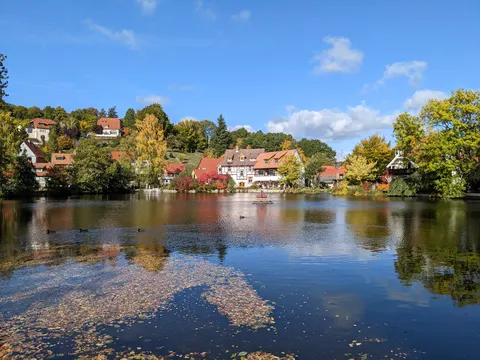
Goslar is a historic town in Lower Saxony, on the north-western slopes of the Harz mountains, and the administrative centre of the Goslar district. Its Old Town and the Rammelsberg mines are UNESCO World Heritage Sites, the mines for their long history of ore mining and the town for its political importance in the Holy Roman Empire. The town was an imperial seat in the Middle Ages.
Goslar, in Lower Saxony, Germany, is home to about 44,000 people and works as a rail hub.
Why go to Goslar?
The Rammelsberg mine, now a museum and visitors' mine, shows how ore was extracted in the Harz for a thousand years. The imperial palace, the Kaiserpfalz, is a reconstruction of the medieval palace where Henry III held court and where Henry IV was born. Henry III's heart was buried in the town. The Old Town's timber houses line its streets, and the medieval cathedral's northern porch survives from the church Henry III had built. Each year Goslar awards the Kaiserring to an international artist, a prize often called the Nobel Prize of the art world.
When is the best time to visit Goslar?
In July and August the average high reaches 21 °C; in January it is closer to 2 °C. For city breaks, go in May, June and September.
How do I get to Goslar without flying?
Goslar has direct train links to 4 destinations. Within 14 hours, travellers from 2,230 destinations can get here without flying. The train from Hildesheim with erixx takes 35 min; that is about 0.8 kg of CO₂ per person. Langelsheim is 5 min away by train with DB Regio AG Nord, with about 0.1 kg of CO₂ per person. Travelling from Bad Harzburg, allow 11 min by train with erixx; that is about 0.2 kg of CO₂ per person.
What to do in Goslar
Rammelsberg
A museum and visitors' mine on the ore and silver deposits that shaped the town's history.
Kaiserpfalz
The imperial palace, a 19th-century reconstruction of the medieval palace where the emperors held court.
Monks' House
The Mönchehaus Museum of Contemporary and Modern Arts, housed in the Monks' House.
Zwinger Tower and Dungeon
A museum of late medieval history in the Zwinger Tower and its dungeon.