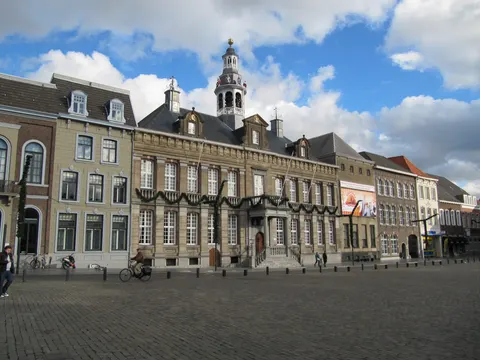
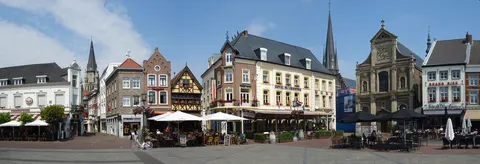
Heinsberg is a town in North Rhine-Westphalia, Germany, and the seat of the district that carries its name. It lies near the Dutch border on the river Wurm, between Sittard and Mönchengladbach. Most of the old town was destroyed in the Second World War, so only a few ancient structures remain. Its neighbours include Wassenberg to the north and Geilenkirchen to the south.
About 42,000 people live in Heinsberg, in North Rhine-Westphalia, Germany, and its station is a rail hub.
Why go to Heinsberg?
Heinsberg is best known for the few historic buildings that survived the Second World War. The town was first mentioned as a town in a document from 1255, and the castle ruins are a reminder of its medieval past. The St. Gangolf church is among the main sights, and the old district court and the former Haus Lennartz are also among the surviving buildings. The Torbogenhaus, the former seat of the Amtmann of the Duchy of Jülich, belongs to a group of buildings that shows the town's administrative past. The Wurm flows into the Rur just outside the town, near Rurkempen.
When is the best time to visit Heinsberg?
Expect daytime highs of about 23 °C in July and August, falling to 5 °C in January.
How do I get to Heinsberg without flying?
You can get to Heinsberg without changing from 2 destinations, by bus or train. With changes, Heinsberg is within 14 hours of 2,222 destinations without flying. From Geilenkirchen, it takes 22 min by train with DB Regio AG NRW, with about 0.2 kg of CO₂ per person. Travelling from Gangelt, allow 30 min by bus; that is about 0.3 kg of CO₂ per person.
What to do in Heinsberg
Adolfosee
A lake in Heinsberg.
Kapelle Marienkloster
A church in Heinsberg.
Travel on from Heinsberg
Direct links run to Geilenkirchen and Gangelt.