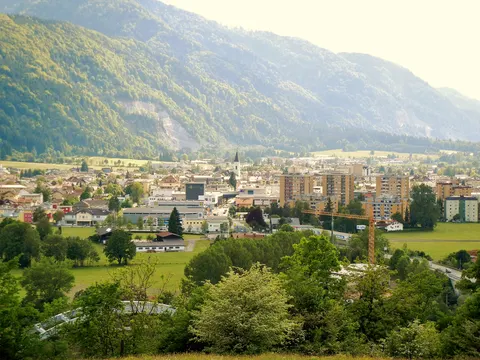
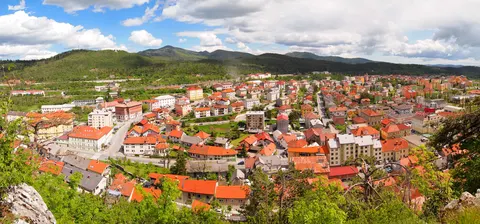
Kufstein is a town in the Austrian state of Tyrol, on the River Inn near the Bavarian border. It is the administrative seat of Kufstein District and, with about 20,000 people, the second largest town in Tyrol after Innsbruck. The town lies in the Lower Inn Valley, between the Brandenberg Alps and the Kaiser Mountains. Its greatest landmark is the fortress, first mentioned in the 13th century, which sits on a rock above the river.
With about 9,848 inhabitants, Kufstein lies in Tyrol, Austria, and is a rail hub.
Why go to Kufstein?
The fortress is built on a rock about 90 metres high, and its round Kaiserturm tower is the most important part. The fortress was used as a prison for political prisoners in the 19th century, and today it is famous for its large organ, the Heldenorgel. The old town has picturesque lanes, the most famous of which is Römerhofgasse, and the city hall stands on the Stadtplatz. A stretch of the medieval city wall is well preserved, and the Wasserbastei on the river is worth seeing.
When is the best time to visit Kufstein?
Average highs range from 3 °C in January to 23 °C in July and August. May, June and September are the time for nature and hiking trips. May, June and September are the time for city breaks.
How do I get to Kufstein without flying?
Direct bus or train services link Kufstein with 8 destinations. Allowing for changes, 2,622 destinations are no more than 14 hours away without flying. Munich is 1h 09m away by train with NS Int, with about 0.9 kg of CO₂ per person. The train from Salzburg with OEBB Personenverkehr AG Kundenservice takes 1h 10m; that is about 0.5 kg of CO₂ per person. From Wörgl, it takes 8 min by train with ÖBB, with about 0.1 kg of CO₂ per person.
What to do in Kufstein
Kufstein Fortress
Built on a rock above the river, with the Kaiserturm tower and the large Heldenorgel organ inside.
Römerhofgasse
The most famous of the picturesque lanes in the old town.
St. Vitus Church
The oldest church of Kufstein, built in Gothic style between 1390 and 1420.
Wasserbastei
A bastion in the northern part of the old centre, on the River Inn, beside a well-preserved stretch of the medieval wall.