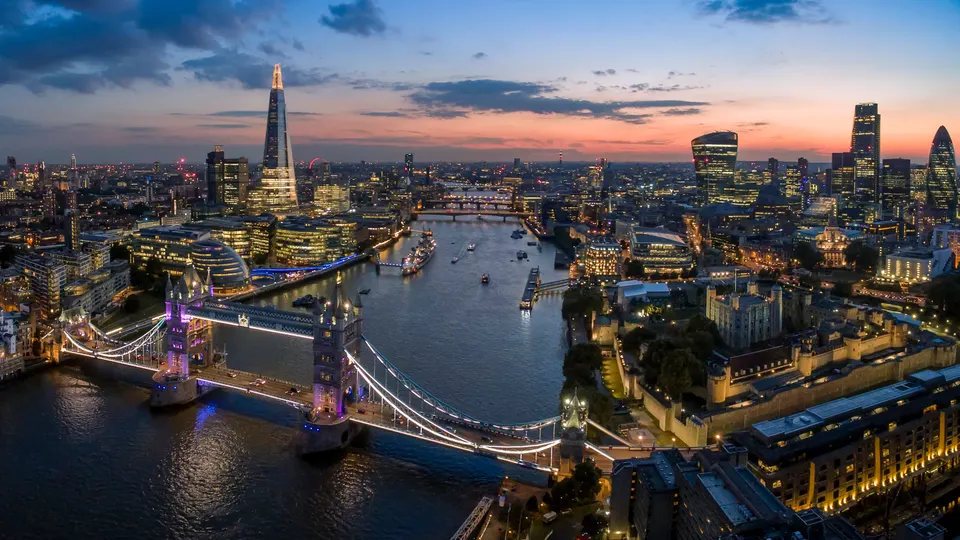

London stands on the River Thames in southeast England, at the head of a tidal estuary that runs down to the North Sea. The Romans founded the city as Londinium, and its ancient core, the City of London, keeps its medieval boundaries. Westminster, just to the west, has housed the national government and parliament for centuries. Today the metropolis is the largest city in England and the United Kingdom.
London, in England, United Kingdom, is home to about 9 million people and works as a rail hub.
Why go to London?
The Tower of London, Westminster Abbey, Buckingham Palace and St Paul's Cathedral are among the landmarks that draw visitors. London has the most museums, art galleries, libraries and cultural venues in the UK, and many of the museums charge no admission. The British Museum, the National Gallery and Tate Modern are among the most visited attractions in the country. The London Underground is the world's oldest rapid transit system, and the St Pancras and Paddington termini are fine examples of Victorian architecture. Theatre is part of the city's life too, with numerous West End theatres and the Wimbledon Tennis Championships and London Marathon as annual events.
When is the best time to visit London?
In July and August the average high reaches 21 °C; in January, February and December it is closer to 7 °C. Any month suits city breaks.
How do I get to London without flying?
London has direct bus or train links to 36 destinations. Within 14 hours, travellers from 2,035 destinations can get here without flying. The train from Paris with Eurostar takes 2h 18m; that is about 2.4 kg of CO₂ per person, 95% less than the 44 kg of a flight. Brussels is 1h 57m away by train with Eurostar, with about 3.5 kg of CO₂ per person against 41 kg for the flight, 91% less. Travelling from Amsterdam, allow 4h 00m by train with Eurostar; that is about 5 kg of CO₂ per person, 89% less than the 46 kg of a flight.
What to do in London
Tower of London
A fortress on the Thames and one of the few structures in central London that predates the Great Fire. At least six ravens are kept there.
British Museum
The first museum to be established in London, in Bloomsbury, with about seven million artefacts from around the globe.
National Gallery
Founded to house the British national collection of Western paintings, it stands in Trafalgar Square beside Nelson's Column.
Tate Modern
One of the most visited attractions in the UK and one of the city's major galleries for modern art.
Westminster Abbey
A landmark in the City of Westminster, the district that has housed the national government and parliament for centuries.