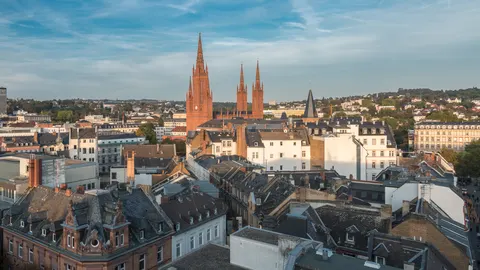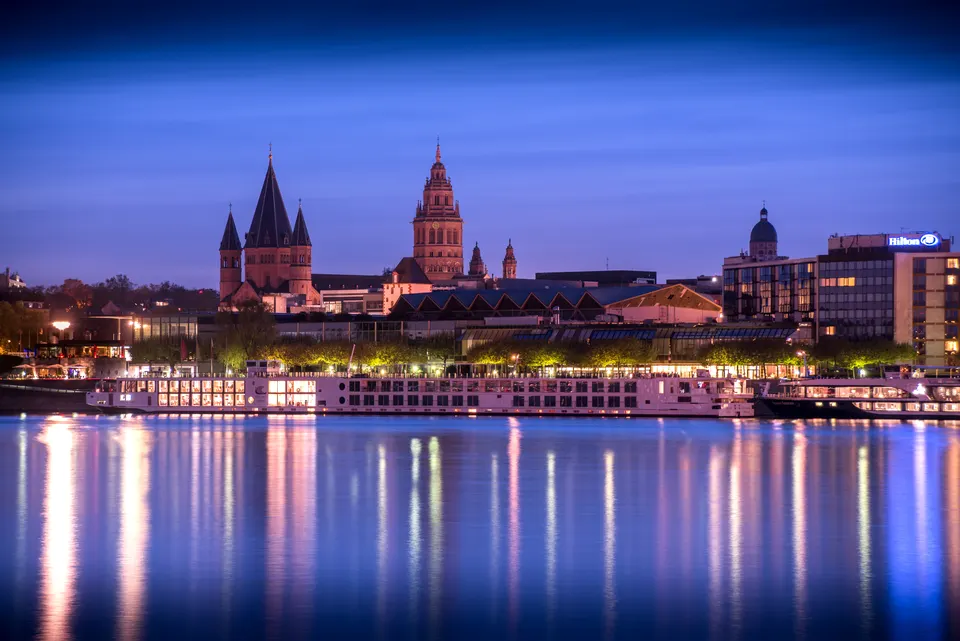

Mainz Cathedral anchors the old town, and its towers are a landmark you can see from many streets. Mainz is the capital of the German state of Rhineland-Palatinate, and it lies in the Rhine-Main region alongside Frankfurt am Main and Wiesbaden. The city has a relaxed, lived-in feel, with churches, a museum devoted to printing and a riverside setting. Walking between the sights is easy, and the riverside is a pleasant place to end the day.
With about 223,000 inhabitants, Mainz lies in Rheinland-Pfalz, Germany, and is a rail hub.
Why go to Mainz?
Mainz suits a day or two of churches, museums and easy walks by the water. The Gutenberg Museum tells the story of printing, and visitors who like books will find it rewarding. The Electoral Palace shows the city's grand past, and the Deutschhaus Mainz is a historic building with a calm feel. St. Stephen's Church and St. Peter's Church are two churches to visit, and the Theodor Heuss Bridge gives you a view along the river. The Arch of Dativius Victor is an old monument of the ancient town, a quiet reminder of the city's long history. Save the late afternoon for a slow walk back through the streets.
When is the best time to visit Mainz?
Average highs range from 4 °C in January and December to 24 °C in July and August. May, June and September are the time for city breaks.
How do I get to Mainz without flying?
Direct bus or train services link Mainz with 12 destinations. Allowing for changes, 2,548 destinations are no more than 14 hours away without flying. Frankfurt is 25 min away by train with VIAS GmbH, with about 0.6 kg of CO₂ per person. The train from Koblenz with DB Fernverkehr AG takes 50 min; that is about 1.1 kg of CO₂ per person. From Wiesbaden, it takes 7 min by train with DB Regio AG Mitte Region Hessen, with about 0.2 kg of CO₂ per person.
What to do in Mainz
Mainz Cathedral
Mainz Cathedral anchors the old town, with a calm interior and a tower that guides you back through the streets. Step inside, then walk toward the river.
Gutenberg Museum
The Gutenberg Museum tells the story of printing, with old presses and early books on display. Allow an hour or two, and pair the visit with a walk through the centre.
Electoral Palace
The Electoral Palace shows the grand side of the city's past, with formal rooms and a broad courtyard. Walk around the outside first, then head toward the cathedral.
Theodor Heuss Bridge
The Theodor Heuss Bridge crosses the water and gives views back over the city. It makes a good walk at the end of a day of sightseeing.