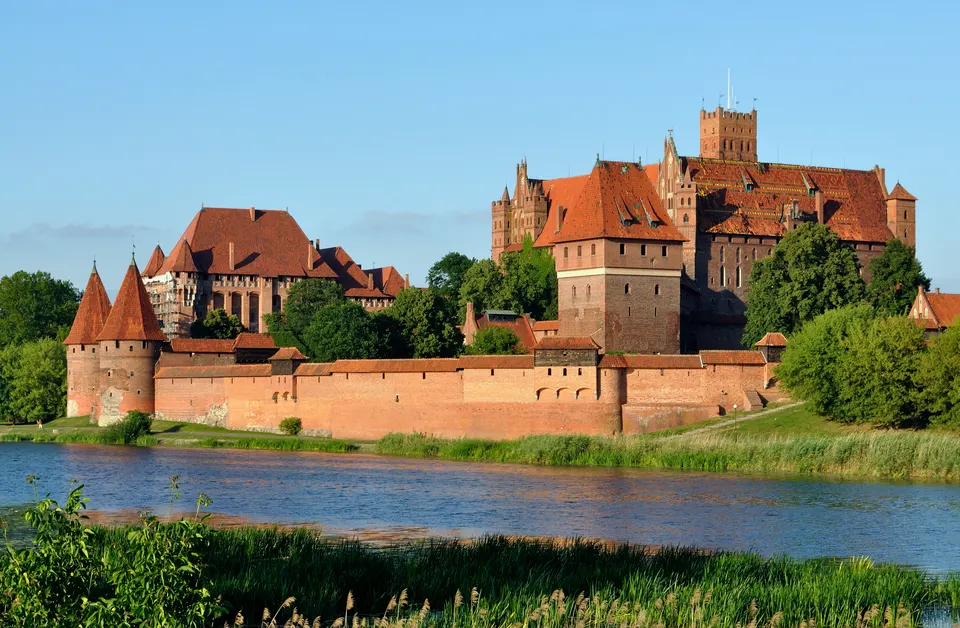

Malbork is a town in the Pomeranian Voivodeship in northern Poland, on the Nogat river in the region of Powiśle. It was founded in the 13th century by the Knights of the Teutonic Order, and its medieval castle is the town's great landmark.
Malbork is in Pomerania, Poland, and has a population of about 37,000.
Why go to Malbork?
Malbork is dominated by its castle, the Teutonic Order's headquarters and Europe's largest Gothic fortress. It was a royal residence of Polish kings for centuries, and the Polish Admiralty was housed there. The complex is three castles combined in one, built over nearly 230 years, and it is the world's largest brick castle. The castle was largely destroyed during the Second World War, and its restoration has continued since. The Gothic town hall and the Gothic church of Saint John the Baptist are also worth a visit.
When is the best time to visit Malbork?
July and August are the warmest, with highs of about 22 °C, and January is the coolest, at about 1 °C.
How do I get to Malbork without flying?
From 4 destinations you can travel to Malbork directly by train. Counting connections, 1,058 destinations can reach it within 14 hours without flying. Travelling from Grudziądz, allow 1h 04m by train with PKP Intercity; that is about 2.1 kg of CO₂ per person. From Tczew, it takes 10 min by train with PKP Intercity, with about 0.6 kg of CO₂ per person. The train from Elbląg with PKP Intercity takes 19 min; that is about 0.9 kg of CO₂ per person.
What to do in Malbork
Zamek w Malborku
A castle in Malbork.
Malbork Castle
A UNESCO World Heritage Site in Malbork.
Travel on from Malbork
Direct links run to Grudziądz, Tczew and Elbląg.