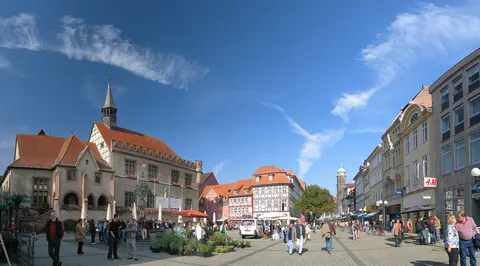
Mühlhausen is a town in the northwest of Thuringia, Germany, on the Unstrut river at the eastern edge of the Hainich hills. It lies in the Thuringian Basin, a flat and fertile area, and serves as the district capital. In the mid-13th century it became a Freie Reichsstadt, an independent, self-governing member of the Holy Roman Empire. It is also the seat of the district that surrounds it.
Mühlhausen, in Thuringia, Germany, is home to about 38,000 people and works as a rail hub.
Why go to Mühlhausen?
Mühlhausen keeps one of the largest medieval city centres in Germany, covering more than 50 hectares inside the inner city wall. Eleven Gothic churches stand within the old town, and a nearly complete fortification still surrounds it. Johann Sebastian Bach worked here as the city's organist for a short spell, and the theologian Thomas Müntzer preached here during the German Peasants' War before being executed outside the walls. The town also gave birth to John A. Roebling, who went on to construct the Brooklyn Bridge. The inner city wall encloses both the old town and the new town, which sit side by side.
When is the best time to visit Mühlhausen?
In July and August the average high reaches 22 °C; in January it is closer to 2 °C. For city breaks, go in May, June and September.
How do I get to Mühlhausen without flying?
Mühlhausen has direct train links to 2 destinations. Within 14 hours, travellers from 2,398 destinations can get here without flying. The train from Göttingen with DB Regio AG Südost takes 49 min; that is about 0.9 kg of CO₂ per person. Bad Langensalza is 10 min away by train with DB Regio AG Südost, with about 0.3 kg of CO₂ per person.
What to do in Mühlhausen
Müntzer memorial in St. Mary's Church
A memorial to Thomas Müntzer inside St. Mary's Church, with an exhibition on him and on local cultural history.
Find tours and tickets: Müntzer memorial in St. Mary's Church
Peasants' War Museum
A museum about the German Peasants' War, housed inside the Corn Market Church.
Wehrgang
A stretch of the medieval city wall beside the Frauentor gate, giving access to the walls and towers.
Museumsgalerie in All Saints Church
Thuringian art from several periods, plus temporary exhibitions of modern art, inside All Saints Church.