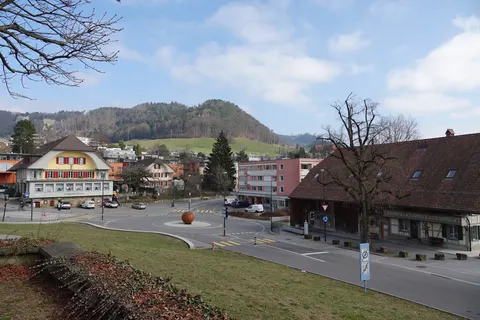
Muri bei Bern is a municipality in the Bern-Mittelland district of the canton of Bern in Switzerland, lying on a terrace above the Aare river. It was first mentioned in 1180, and archaeological finds show that the area was settled already in Roman times. Industrialisation and the trains from the city to the countryside changed the village in the early twentieth century.
With about 13,000 inhabitants, Muri lies in Bern, Switzerland, and is a rail hub.
Why go to Muri?
Muri is a place to combine river and history. The Aare gives the municipality its natural setting, with the Aarebad Muri swimming site on its banks and a natural protected area along the river. The Auguetbrücke, a bridge across the Aare finished in 1836, links the two sides. Country estates such as the Hofgut and Villa Mettlen recall the wealthy families who lived here, and the Muri Church is a Swiss Reformed church. Between Belp and Köniz, ferries still run between Bern and Thun along the Aare.
When is the best time to visit Muri?
Average highs range from 4 °C in January to 23 °C in July.
How do I get to Muri without flying?
Direct train services link Muri with 6 destinations. Allowing for changes, 2,319 destinations are no more than 14 hours away without flying. Bern is 3 min away by train with BLS AG (bls), with about 0 kg of CO₂ per person. The train from Thun with BLS AG (bls) takes 17 min; that is about 0.1 kg of CO₂ per person. From Ittigen, it takes 3 min by train with BLS AG (bls), with about 0 kg of CO₂ per person.
What to do in Muri
Muri Church
A Swiss Reformed church in the municipality, one of its historic landmarks.
Auguetbrücke
A bridge across the Aare, finished in 1836.
Aarebad Muri
A popular swimming site on the banks of the Aare.
Hofgut
A country estate in Muri, one of the historic estates of the area.