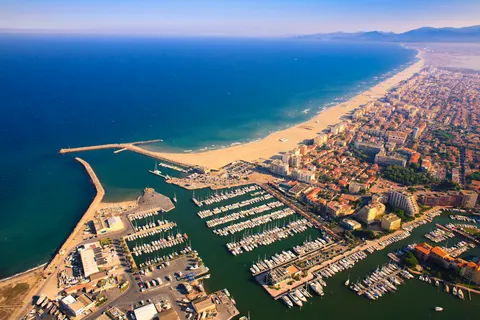

Narbonne is a commune and subprefecture in southern France, in the Occitanie region and the Aude department. It lies about 15 km from the Mediterranean and was once a prosperous port. From the 14th century onwards it declined after the river Aude changed course. Today it is the largest commune in the department, although the capital of Aude is the smaller commune of Carcassonne. Its name goes back to the Roman Narbo.
About 51,000 people live in Narbonne, in Occitanie, France, and its station is a rail hub.
Why go to Narbonne?
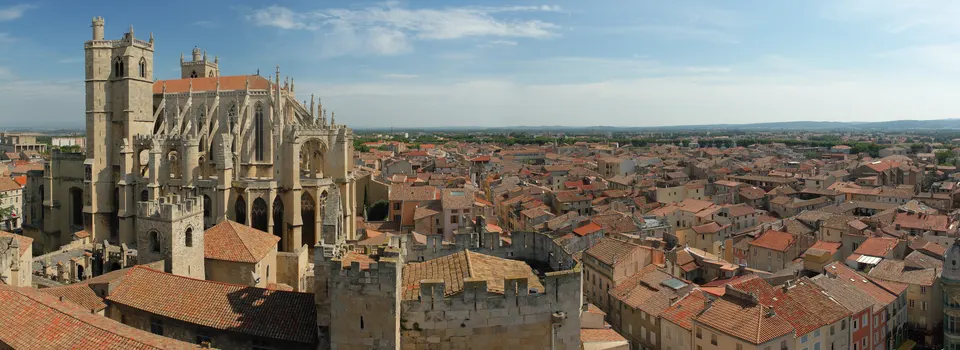
Narbonne is best known for its Roman past, which lies both underground and in the streets. The Roman Horreum, a former grain warehouse, was built underground as a cryptoporticus, and remains of the Via Domitia can still be seen in the city centre. At Clos de la Lombarde, an archaeological site shows Roman townhouses, bath houses and workshops, along with the first Christian basilica in the town. The Cathedral Saint-Just-et-Saint-Pasteur dates from 1272, and the Palace of the Archbishops has a donjon with views over the city. The Canal de la Robine runs through the centre and links the town to the Canal du Midi.
When is the best time to visit Narbonne?
Expect daytime highs of about 29 °C in July, falling to 11 °C in January and December. For city breaks, any month of the year works.
How do I get to Narbonne without flying?
You can get to Narbonne without changing from 13 destinations, by bus or train. With changes, Narbonne is within 14 hours of 1,963 destinations without flying. From Barcelona, it takes 2h 55m by bus with FlixBus-eu, with about 5.7 kg of CO₂ per person against 27 kg for the flight, 79% less. Travelling from Toulouse, allow 1h 44m by bus with FlixBus-eu; that is about 3.6 kg of CO₂ per person. Marseille is 2h 56m away by bus with FlixBus-eu, with about 5.2 kg of CO₂ per person against 44 kg for the flight, 88% less.
What to do in Narbonne
Cathedral Saint-Just-et-Saint-Pasteur
Dating from 1272, it is the town's cathedral, named after Saints Just and Pastor.
Find tours and tickets: Cathedral Saint-Just-et-Saint-Pasteur
Palace of the Archbishops
A monument historique whose donjon has views over the city.
Clos de la Lombarde
An archaeological site with the remains of Roman townhouses, bath houses and workshops, and the first Christian basilica in Narbonne.
Roman Horreum
A former grain warehouse built underground as a cryptoporticus, one of the town's Roman remains.