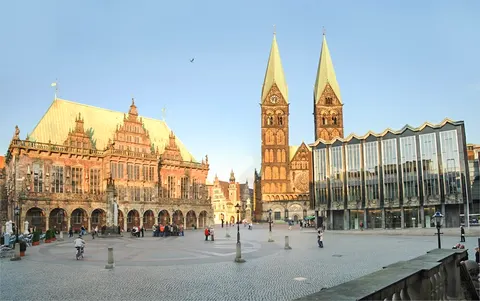
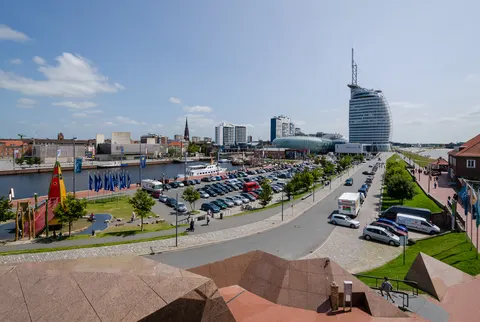
Oldenburg is an independent city in Lower Saxony in north-western Germany, on the rivers Hunte and Haaren, between Bremen to the east and Groningen in the Netherlands to the west. It is the place of origin of the House of Oldenburg, and before the end of the German Empire it was the administrative centre and residence of the monarchs of Oldenburg. The city is officially named Oldenburg (Oldb) to tell it apart from Oldenburg in Holstein.
Oldenburg, in Lower Saxony, Germany, is home to about 159,000 people and works as a rail hub.
Why go to Oldenburg?
Oldenburg's character is shaped by its position on the Hunte, where a ford once made the town important. The town was the capital of a small state that lived in the shadow of the Hanseatic city of Bremen. After a plague and a fire struck the town in an earlier era, the destroyed buildings were rebuilt in a neoclassicist style once Danish rule ended. The city is surrounded by farmland, most of it grassland used for dairy cows, and asparagus, grains and kale are also grown in the region.
When is the best time to visit Oldenburg?
In July the average high reaches 22 °C; in January it is closer to 4 °C. For city breaks, go in May, June and September.
How do I get to Oldenburg without flying?
Oldenburg has direct bus or train links to 4 destinations. Within 14 hours, travellers from 2,135 destinations can get here without flying. The train from Bremen with NordWestBahn takes 27 min; that is about 0.7 kg of CO₂ per person. Groningen is 1h 35m away by bus with FlixBus-eu, with about 3 kg of CO₂ per person. Travelling from Osnabrück, allow 1h 23m by train with NordWestBahn; that is about 1.7 kg of CO₂ per person.
What to do in Oldenburg
Horst Janssen Museum
A museum in Oldenburg.
Drielaker See
A lake in Oldenburg.
Augusteum
A museum in Oldenburg.
Botanischer Garten
A park in Oldenburg.
City breaks in Oldenburg
June is the ideal month for city breaks, with average highs of 19 °C.