
Padua is a city in the Veneto region of northern Italy, on the banks of the Bacchiglione river and a short distance west of Venice. It is the economic and communications hub of the area and part of a metropolitan area shared with Venice and Treviso. The city is known for one of the oldest universities in the world, where Galileo and Copernicus taught or studied, and for its gardens and frescoes, which are UNESCO World Heritage.
About 204,000 people live in Padua, in Veneto, Italy, and its station is a rail hub.
Why go to Padua?
Padua is a city of learning and painting. The Scrovegni Chapel, built as a private chapel beside a banker's palace, holds a fresco cycle by Giotto, finished in 1305, that is among the most important in European painting. Visitors wait in a climate-controlled airlock before entering to protect the frescoes. Nearby, the Palazzo della Ragione has a great hall whose roof is reputed to be one of Europe's largest unsupported by columns, and a centuries-old market runs beneath it. The Basilica of Sant'Antonio, known locally as Il Santo, holds the saint's bones.
When is the best time to visit Padua?
Expect daytime highs of about 29 °C in July and August, falling to 7 °C in January. For city breaks, any month of the year works.
How do I get to Padua without flying?
You can get to Padua without changing from 13 destinations, by bus or train. With changes, Padua is within 14 hours of 2,227 destinations without flying. From Rome, it takes 5h 45m by bus with FlixBus-eu, with about 11 kg of CO₂ per person against 90 kg for the flight, 88% less. Travelling from Venice, allow 18 min by train with Trenitalia; that is about 1 kg of CO₂ per person. Bologna is 1h 35m away by bus with FlixBus-eu, with about 3 kg of CO₂ per person.
What to do in Padua
Scrovegni Chapel
Also called the Arena Chapel, it stands on the site of a Roman-era arena and has frescoes on the life of the Virgin Mary.
Basilica di Sant'Antonio
Known locally as Il Santo, it holds the bones of the saint in a richly decorated chapel of carved marble.
Prato della Valle
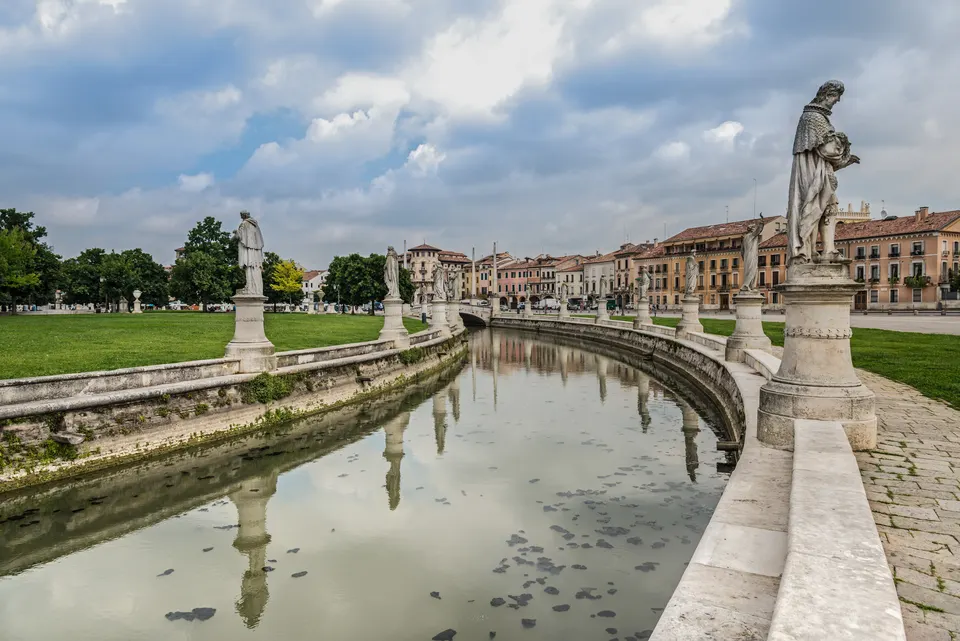
One of the largest squares in Europe, with a central garden ringed by an oval canal and lined with statues of illustrious citizens.
Palazzo della Ragione
A great hall on the upper floor, with allegorical frescoes on its walls and a market beneath it.