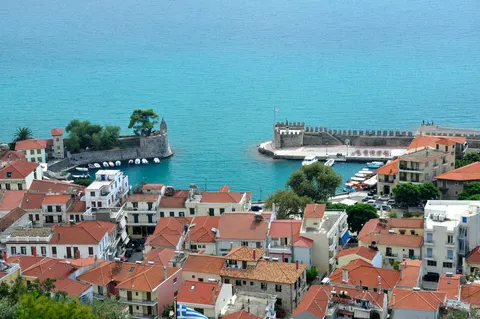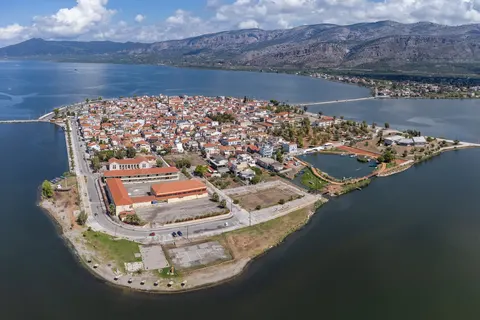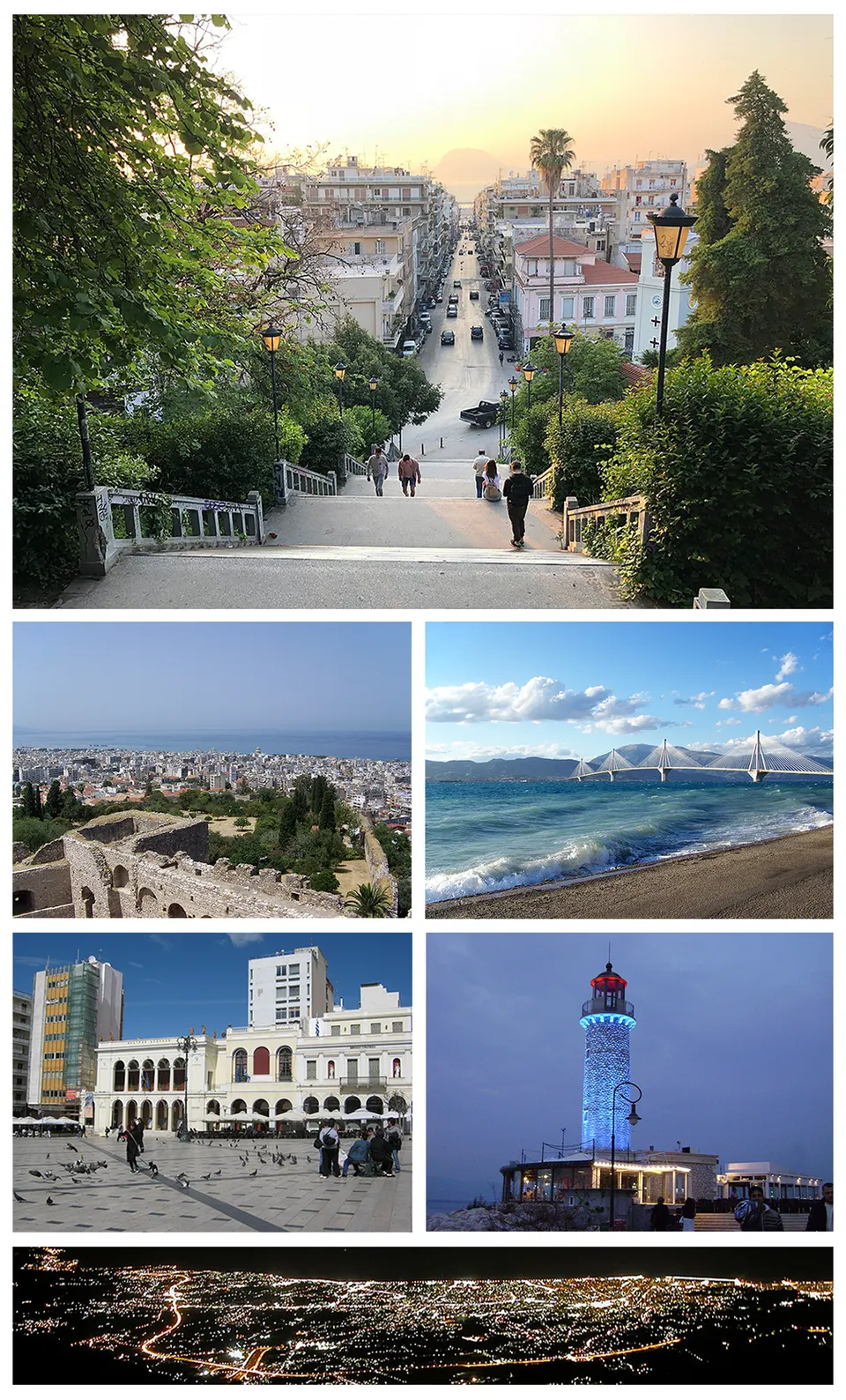

Patras is the capital and largest city of Western Greece, on the northern Peloponnese, at the foot of Mount Panachaikon and overlooking the Gulf of Patras. It is Greece's third-largest city and is known as the Gate to the West. Its busy port is a nodal point for trade and communication with Italy and the rest of Western Europe.
About 168,000 people live in Patras, in West Greece, Greece, and its station is a rail hub.
Why go to Patras?
The Patras Carnival, held every February, is one of Europe's largest, with mammoth satirical floats and parades. The Roman Odeon, built around 160 AD, stands in the upper town and is used as an open-air theatre in summer. The medieval castle on the ancient acropolis was begun by Justinian and expanded under Frankish and Venetian rule, and its interior is now a public garden. The Rio-Antirrio Bridge, one of the world's longest multi-span cable-stayed bridges, connects the Peloponnese with mainland Greece. The city was European Capital of Culture in 2006.
When is the best time to visit Patras?
Expect daytime highs of about 31 °C in July and August, falling to 12 °C in January and February. For city breaks, any month of the year works.
How do I get to Patras without flying?
You can get to Patras without changing from 9 destinations, by bus, ferry or train. With changes, Patras is within 14 hours of 32 destinations without flying. From Corfu, it takes 6h 00m by ferry with Grimaldi / ANEK, with about 10 kg of CO₂ per person against 50 kg for the flight, 80% less. Travelling from Náfpaktos, allow 1h 00m by bus with KTEL Achaia; that is about 0.5 kg of CO₂ per person. Mesolóngi is 1h 30m away by bus with KTEL Achaia, with about 0.8 kg of CO₂ per person.
What to do in Patras
Patras Castle
A medieval castle on the ancient acropolis above the city, now used as a public garden.
Roman Odeon
A Roman open-air theatre in the upper town, restored and used for summer concerts.
Church of Saint Andrew
The Orthodox church of the city's patron saint, containing relics at the place of his crucifixion, with a central cupola 46 metres tall.
Apollon Theatre
A neoclassical theatre built in 1872 in the central square and designed by Ernst Ziller.