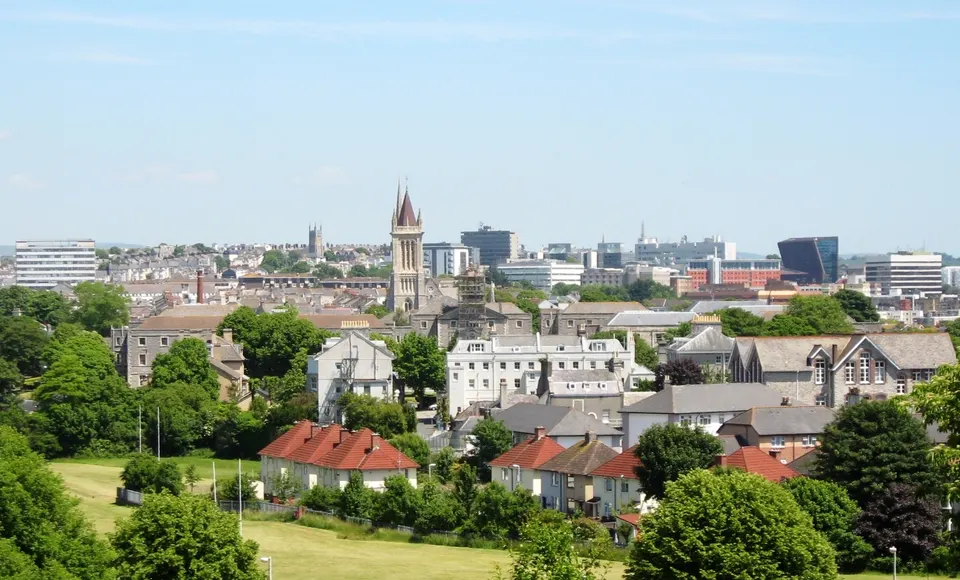

Plymouth is a port city on England's south coast, set between the rivers Plym and Tamar where both reach Plymouth Sound. It is the largest settlement in Devon and the second-largest city in the South West after Bristol. The town began as a trading post in the Bronze Age, grew into a Royal Navy base, and today combines shipping, services and a university.
Plymouth, in England, United Kingdom, is home to about 260,000 people and works as a rail hub.
Why go to Plymouth?
Plymouth's seafaring past is the first thing to notice. HMNB Devonport, on the Tamar, is the largest operational naval base in Western Europe, and ferries leave the port for Brittany and Spain. Above the Sound, the Hoe is a flat clifftop where Drake's Island comes into view across the water. The city was heavily damaged in the Second World War and rebuilt afterwards, so the centre looks largely modern, though the Barbican keeps the older waterfront alive, on the site of the medieval village of Sutton. Theatre Royal Plymouth brings West End productions to the city, alongside smaller work.
When is the best time to visit Plymouth?
In July and August the average high reaches 19 °C; in February it is closer to 8 °C. Any month suits city breaks.
How do I get to Plymouth without flying?
Plymouth has direct bus, ferry or train links to 12 destinations. Within 14 hours, travellers from 1,538 destinations can get here without flying. The train from London with GWR takes 3h 00m; that is about 4 kg of CO₂ per person, 94% less than the 71 kg of a flight. Saint-Malo is 10h 00m away by ferry with Brittany Ferries, with about 4.7 kg of CO₂ per person against 31 kg for the flight, 85% less. Travelling from Exeter, allow 1h 05m by bus with FlixBus-gb; that is about 1.6 kg of CO₂ per person.
What to do in Plymouth
Plymouth Hoe
A flat public area on top of limestone cliffs above Plymouth Sound, with Drake's Island in view across the water.
Plymouth Breakwater
A breakwater in use since 1814 that shelters Plymouth Sound from the sea.
Theatre Royal Plymouth
The city's main theatre, with three performance spaces and a programme that ranges from West End shows to smaller works.
Royal Citadel
The setting for the Music of the Night celebration, which the 29 Commando Regiment and local performers staged there between 1992 and 2012 to raise money for charity.