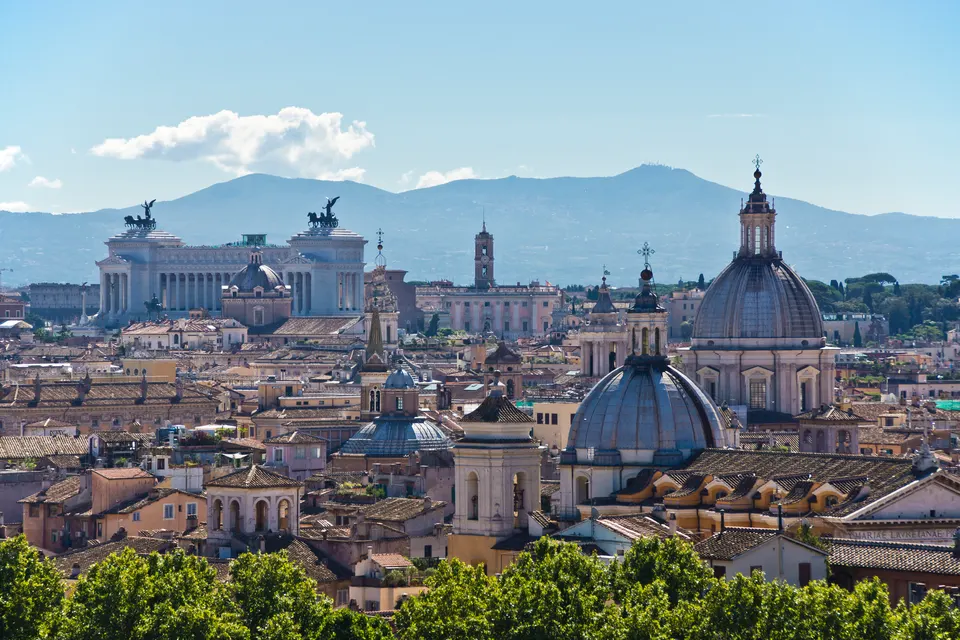

Rome is the capital of Italy and the administrative centre of the Lazio region, on the Tiber. It is one of the oldest continuously occupied cities in Europe, and the poet Tibullus called it the Eternal City in the 1st century BC. Rome has been the capital of the Roman Republic, the Empire and later the Papal States. Vatican City, the smallest country in the world, sits inside its boundaries.
About 2.3 million people live in Rome, in Lazio, Italy, and its station is a rail hub.
Why go to Rome?
Rome is built in layers of history. Palatine Hill is where the city is thought to have grown from early pastoral settlements, above what became the Roman Forum. The Renaissance popes brought in the era's best artists, including Michelangelo and Raphael, so the Sistine Chapel and the new Saint Peter's Basilica stand in Vatican City beside Roman ruins. Ponte Sisto, the first bridge across the Tiber since antiquity, was built on Roman foundations. Cinecittà Studios, where many Academy Award-winning films were shot, adds a more modern note to the story. The historic centre is listed by UNESCO as a World Heritage Site.
When is the best time to visit Rome?
Expect daytime highs of about 30 °C in July and August, falling to 12 °C in January, February and December. For city breaks, any month of the year works.
How do I get to Rome without flying?
You can get to Rome without changing from 38 destinations, by bus, ferry or train. With changes, Rome is within 14 hours of 1,701 destinations without flying. From Siena, it takes 2h 39m by bus with FlixBus-eu, with about 5 kg of CO₂ per person against 42 kg for the flight, 88% less. Travelling from Milan, allow 3h 00m by train with Trenitalia; that is about 4 kg of CO₂ per person, 96% less than the 109 kg of a flight. Florence is 1h 32m away by train with altoadigemobilità, with about 2.9 kg of CO₂ per person against 53 kg for the flight, 95% less.
What to do in Rome
Sistine Chapel
One of the Renaissance works made when the popes engaged the era's best artists, including Michelangelo.
Saint Peter's Basilica
The new basilica built during the Renaissance, replacing an older church that had been demolished, now in Vatican City.
Palatine Hill
The hill where the city's earliest settlements are thought to have grown, above the future Roman Forum.
Ponte Sisto
A bridge over the Tiber, the first built across the river since antiquity, on Roman foundations.