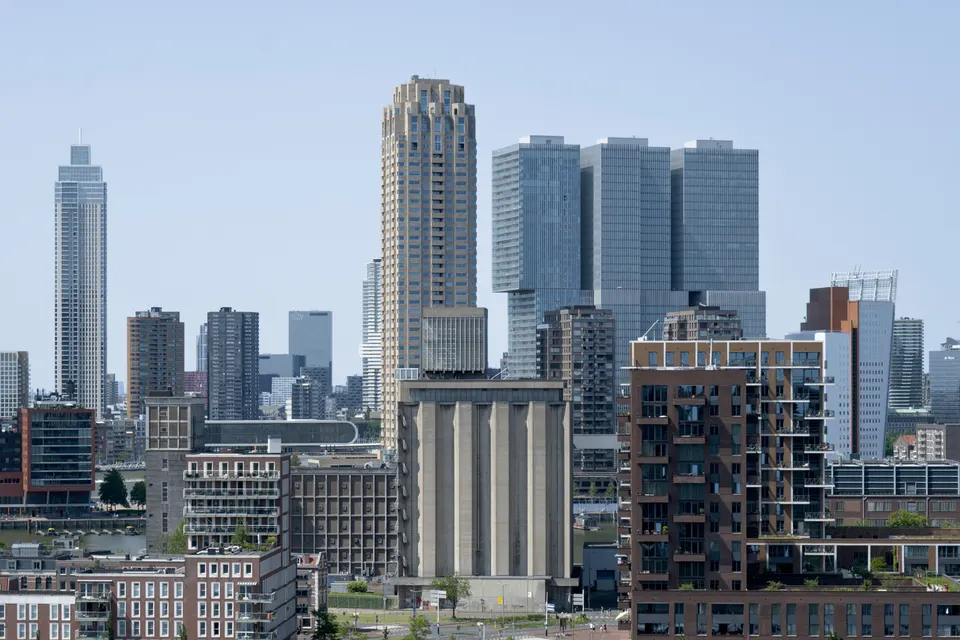

Rotterdam sits on the New Meuse channel in the Rhine-Meuse-Scheldt delta, where the river meets the North Sea. It is the Netherlands' second-largest city and the largest by area, and it holds Europe's biggest seaport. Much of the centre was destroyed in the Second World War, so the city has rebuilt itself as a showcase of modern architecture, from skyscrapers to the new districts on the south bank.
Rotterdam is in South Holland, Netherlands, and has a population of about 868,000; it is also a rail hub.
Why go to Rotterdam?
People come for the architecture first. Rotterdam is known worldwide for its modern buildings, and the Van Nelle Factory, a 1929 design by Brinkman and Van der Vlugt, is a UNESCO World Heritage Site. Architects such as Rem Koolhaas, MVRDV and Ben van Berkel shaped the skyline, which includes the Maastoren and the Zalmhaven Tower. The Museum Boijmans Van Beuningen and the Wereldmuseum add art and culture, and the Rotterdam Philharmonic Orchestra plays at De Doelen. Lift bridge De Hef, preserved in its raised position, is a sight in its own right.
When is the best time to visit Rotterdam?
July and August are the warmest, with highs of about 21 °C, and January, February and December are the coolest, at about 6 °C. Any month suits city breaks.
How do I get to Rotterdam without flying?
From 24 destinations you can travel to Rotterdam directly by bus, ferry or train. Counting connections, 2,178 destinations can reach it within 14 hours without flying. Travelling from Brussels, allow 1h 10m by train with NS Int; that is about 1.6 kg of CO₂ per person. From Amsterdam, it takes 42 min by train with Eurostar, with about 0.9 kg of CO₂ per person. The bus from Lille with BlaBlaCar Bus takes 3h 15m; that is about 4.7 kg of CO₂ per person, 79% less than the 22 kg of a flight.
What to do in Rotterdam
Van Nelle Factory
A factory by Brinkman and Van der Vlugt, regarded as a monument of modern factory design and now a UNESCO World Heritage Site.
De Hef
A former railway lift bridge, preserved as a national heritage site in its lifted position between Noordereiland and the south of the city.
Witte Huis
Completed in 1898 and inspired by American office buildings, it was then the tallest office block in Europe.
Netherlands Architecture Institute
Open to the public, with exhibitions on architecture and urban planning issues.