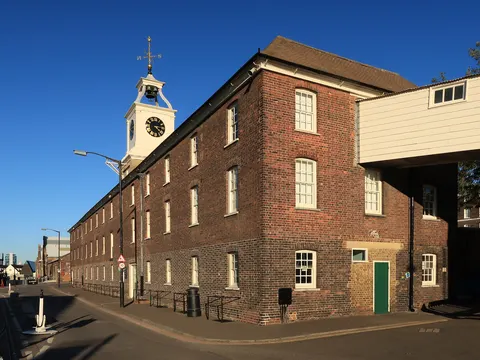
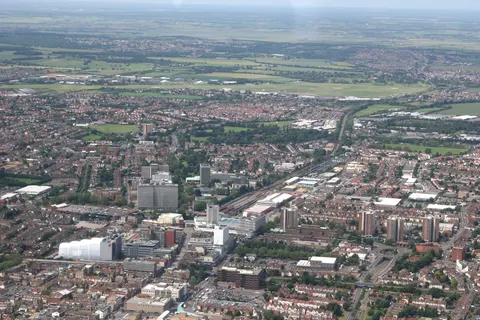
Sittingbourne is an industrial town in the Swale district of Kent, in southeast England, beside the Roman Watling Street, an ancient trackway. It stands next to the Swale, a strip of sea separating mainland Kent from the Isle of Sheppey. In 2021 the town had a population of 54,392.
With about 54,000 inhabitants, Sittingbourne lies in England, United Kingdom, and is a rail hub.
Why go to Sittingbourne?
The town grew up as a convenient resting point on the road from London to Canterbury and Dover, a role it gained after the death of Thomas Becket. Its name comes from a small stream, or bourne, that runs underground in part of the town, and an older form, Sedingbourne, means the hamlet by the bourne. Medieval Kent records name it Sydingeburn, and a later history of Kent ties the name to that stream. Its past is bound up with the Roman Watling Street, the ancient trackway that still runs beside the town.
When is the best time to visit Sittingbourne?
Average highs range from 7 °C in January, February and December to 21 °C in July and August.
How do I get to Sittingbourne without flying?
Direct bus or train services link Sittingbourne with 4 destinations. Allowing for changes, 1,481 destinations are no more than 14 hours away without flying. Southend-on-Sea is 1h 42m away by bus, with about 0.6 kg of CO₂ per person. The train from Margate with Southeastern takes 1h 30m; that is about 0.5 kg of CO₂ per person. From Folkestone, it takes 1h 12m by train with Southeastern, with about 0.5 kg of CO₂ per person.
What to do in Sittingbourne
Sittingbourne Heritage Museum
A museum in Sittingbourne.
Travel on from Sittingbourne
Direct links run to Southend-on-Sea, Margate and Folkestone.
Compare the trip with flying
The trip planner compares train, bus and ferry options to Sittingbourne with a flight, including CO₂.