
Sóller is a town on the north-west coast of the Balearic island of Mallorca, in a large bowl-shaped valley about 3 km inland from Port de Sóller. The population is around 14,000, and the valley also includes the village of Fornalutx and several hamlets. The Tranvía de Sóller tram links the town to the port, and the town is known for its historic streets and Modernista houses.
About 14,000 people live in Sóller, in Balearic Islands, Spain, and its station is a rail hub.
Why go to Sóller?
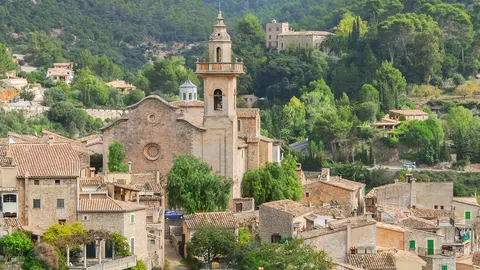
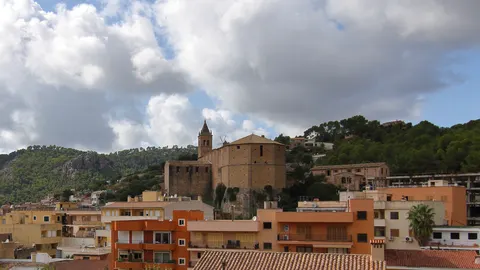
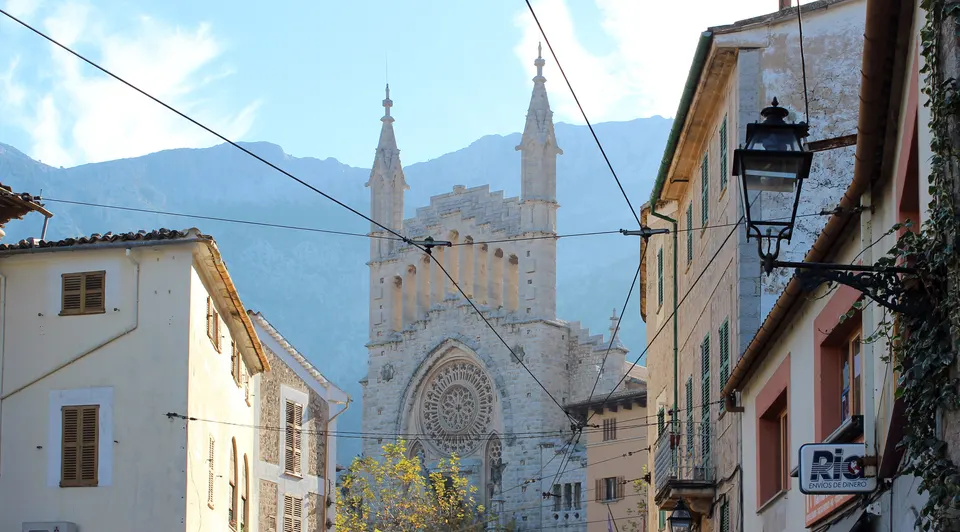
The town centre is the Plaça Constitució, a square lined with cafés, plane trees and a fountain. Its church of Sant Bartomeu faces the square, and its original building dates from before 1236, though the interior is now largely baroque. The old street plan is of Islamic origin and lined with houses from the sixteenth to eighteenth centuries. Houses built in the early twentieth century by emigrants who returned wealthy reflect the Art Nouveau styles of France, especially along the Gran Via. A renowned botanical garden lies on the edge of town.
When is the best time to visit Sóller?
Expect daytime highs of about 29 °C in July and August, falling to 13 °C in January and February. If you are after beach holidays, aim for June, July and September. If you are after nature and hiking trips, aim for April, May and November. For city breaks, any month of the year works.
How do I get to Sóller without flying?
You can get to Sóller without changing from 2 destinations, by bus or train. With changes, Sóller is within 14 hours of 123 destinations without flying. From Palma de Mallorca, it takes 1h 00m by train with Ferrocarril de Sóller, with about 0.2 kg of CO₂ per person. Travelling from Valldemossa, allow 42 min by bus with TIB; that is about 0.3 kg of CO₂ per person.
What to do in Sóller
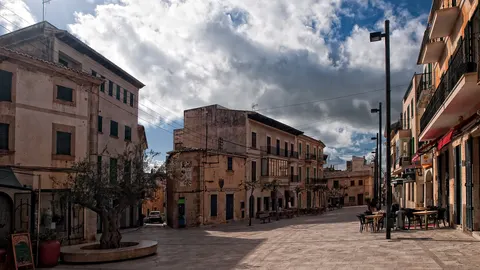
Plaça Constitució
The town's main square, with a fountain and plane trees at its centre. The tram passes through it on its way to and from the station.
Church of Sant Bartomeu
It faces the east side of the square and is flanked by the town hall. Its neo-Gothic belltower and largely baroque interior make it stand out above the town.
Banco de Sóller building
A 1912 Modernista building with defining ironwork, by the Catalan architect Joan Rubió i Bellver, a follower of Antoni Gaudí.
Jardí Botànic
The botanical garden on the edge of town, laid out with plants of the Balearics and the Mediterranean islands, with a Modernista mansion that houses a natural sciences museum.