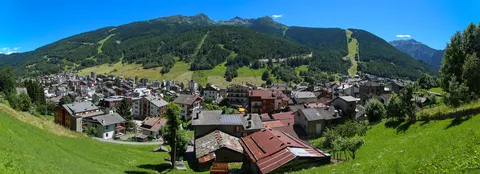
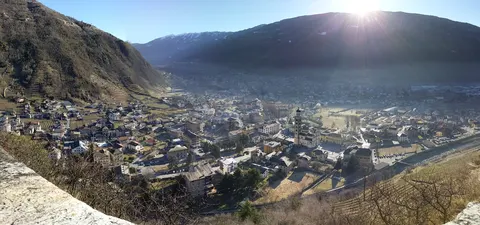
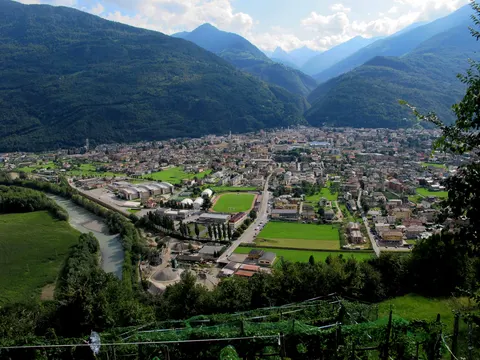
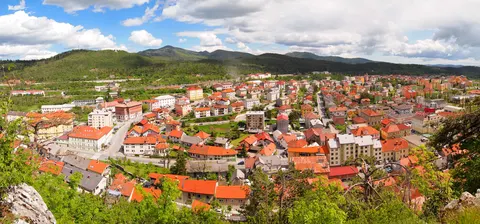
Sondrio is an Italian city and the administrative centre of the province of the same name, in the heart of the Valtellina in Lombardy. It was founded by the Lombards on the site of a former Roman military camp. In 2007 the town was named Alpine Town of the Year, and it sits in an Alpine valley that has shaped its history for centuries.
Sondrio is in Lombardy, Italy, and has a population of about 19,000.
Why go to Sondrio?
The heart of Sondrio is its central Garibaldi Square, and the Palazzo Sassi nearby houses the Art and History Museum of Valtellina. Masegra Castle occupies a dominant position near the ancient road to the Valmalenco and houses the Historical Museum of the Grisons Domination, a reminder of the years the valley was governed by the Grisons. The church of Santi Gervasio e Protasio began as a Romanesque collegiate church and was rebuilt in neoclassical style in 1838. Across the railway, the Church of Maria della Sassella is a diocesan Marian sanctuary whose origins local tradition places in the 10th century.
When is the best time to visit Sondrio?
July and August are the warmest, with highs of about 26 °C, and January and December are the coolest, at about 6 °C. For nature and hiking trips, go in May, September and October.
How do I get to Sondrio without flying?
From 5 destinations you can travel to Sondrio directly by bus. Counting connections, 1,017 destinations can reach it within 14 hours without flying. Travelling from Livigno, allow 2h 00m by bus; that is about 1.2 kg of CO₂ per person. From Aprica, it takes 1h 45m by bus, with about 0.6 kg of CO₂ per person. The bus from Foppolo takes 1h 45m; that is about 0.5 kg of CO₂ per person.
What to do in Sondrio
Garibaldi Square
The central square of the town, with the Palazzo Sassi close by.
Palazzo Sassi
Home of the Art and History Museum of Valtellina, near the central square.
Masegra Castle
Stands in a dominant position near the ancient road to the Valmalenco and houses the Historical Museum of the Grisons Domination.
Church of Maria della Sassella
A diocesan Marian sanctuary across the railway, whose origins local tradition dates to the 10th century.