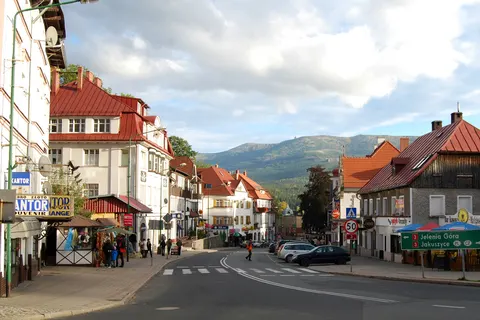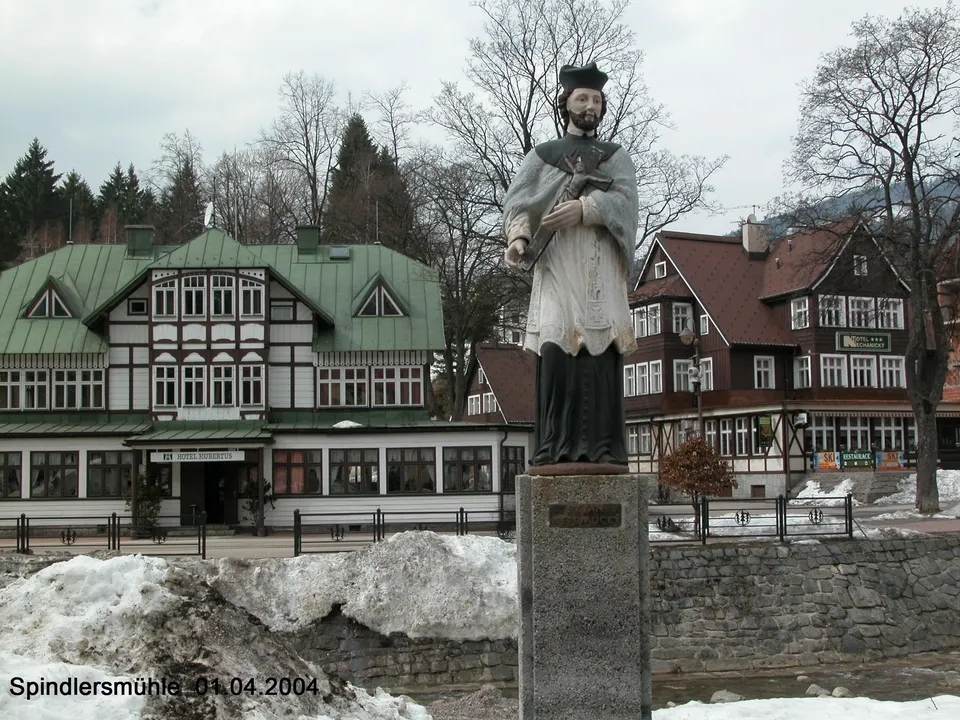

Špindlerův Mlýn is a town in Trutnov District in the Hradec Králové Region of the Czech Republic. It lies in the Giant Mountains, in a valley between the Medvědín mountain and the ridges of Kozí hřbety and Pláň, on the upper course of the Elbe River. The town has about 1,100 inhabitants and is one of the most frequented ski resorts in the country. The Elbe rises nearby, on the slopes of the Violík mountain, close to the Polish border.
With about 1,089 inhabitants, Špindlerův Mlýn lies in Hradec Králové Region, Czech Republic.
Why go to Špindlerův Mlýn?
Špindlerův Mlýn is a ski town with a story that goes back to the 16th century, when miners and lumberjacks settled in the forest. The mountain pastures and clearings they opened still shape the landscape, and the town's winter tourism grew from that settlement. Luční hora, the second-highest mountain in the Czech Republic, rises to the east. The Pančava Waterfall is the highest waterfall in the country, and the Elbe Falls sit close to the town. The town's main historical landmark is a neoclassical church, and the old reinforced concrete arch bridge, known as the white bridge, is a notable technical monument.
When is the best time to visit Špindlerův Mlýn?
Average highs range from -2 °C in January to 19 °C in July. Skiing works best in January, February and December. June, July and August are the time for nature and hiking trips.
How do I get to Špindlerův Mlýn without flying?
Direct bus services link Špindlerův Mlýn with 2 destinations. Allowing for changes, 1,103 destinations are no more than 14 hours away without flying. Janské Lázně is 30 min away by bus, with about 0.2 kg of CO₂ per person. The bus from Pec pod Sněžkou takes 36 min; that is about 0.3 kg of CO₂ per person.
What to do in Špindlerův Mlýn
Elbe Falls (Labský vodopád)
A cascade on the upper Elbe, a short way downstream from the river's source.
Pančava Waterfall
The highest waterfall in the Czech Republic, on the Pančava stream near the Elbe Falls.
Church of Saints Peter and Paul
The town's main historical landmark, a neoclassical church built in 1807.
Bílý most (white bridge)
A reinforced concrete arch bridge from 1911, recognised as a notable technical monument.