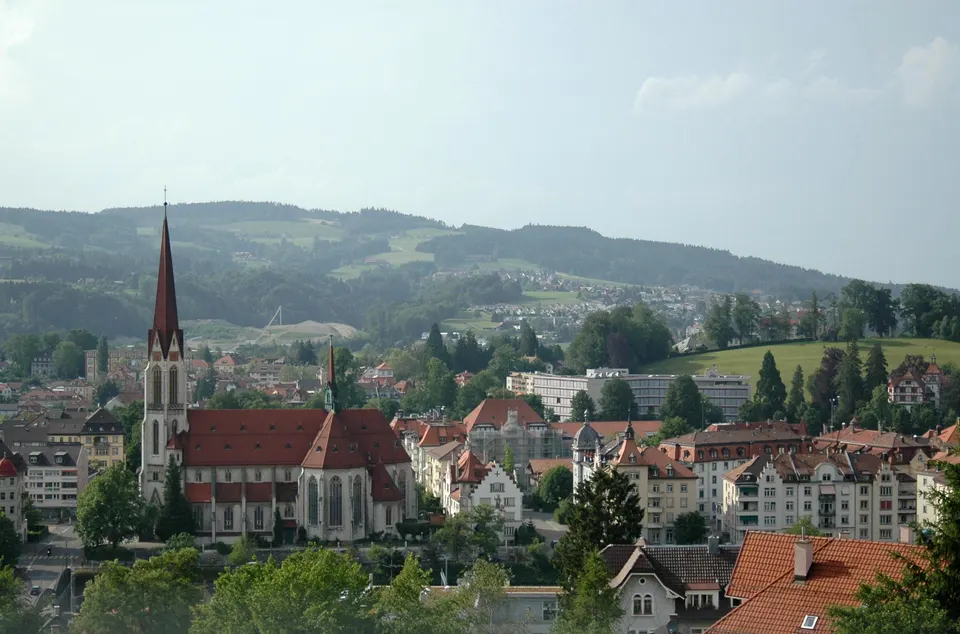

St. Gallen is a Swiss city and the capital of the canton of St. Gallen. It grew around the Abbey of St Gall, built in the 8th century, and today it is the centre of eastern Switzerland. The city is home to the University of St. Gallen, and its abbey is a UNESCO World Heritage Site. St. Gallen also serves as the gateway to the Appenzellerland.
St. Gallen is in Saint Gallen, Switzerland, and has a population of about 76,000; it is also a rail hub.
Why go to St. Gallen?
The Abbey of St. Gall is the main draw, a UNESCO World Heritage Site whose library holds books from the 9th century. The city grew around the hermitage of the Irish missionary Gallus, and the abbey later became a centre of pilgrimage and trade. In the years before the First World War, embroidery became the largest export branch of the region, and the city's textile past still shows in its museums. Those museums range from a textile museum with historical laces and cloth to a beer bottle museum at the Schützengarten brewery, the oldest in Switzerland. The museums cover a wide range of subjects, from natural history to art brut.
When is the best time to visit St. Gallen?
July and August are the warmest, with highs of about 21 °C, and January is the coolest, at about 2 °C. City breaks work best in May, June and September.
How do I get to St. Gallen without flying?
From 11 destinations you can travel to St. Gallen directly by bus or train. Counting connections, 2,459 destinations can reach it within 14 hours without flying. Travelling from Munich, allow 3h 15m by bus with FlixBus-eu; that is about 4.9 kg of CO₂ per person, 79% less than the 23 kg of a flight. From Bregenz, it takes 26 min by train with Schweizerische Bundesbahnen SBB, with about 0.1 kg of CO₂ per person. The train from Konstanz with THURBO takes 32 min; that is about 0.3 kg of CO₂ per person.
What to do in St. Gallen
Abbey of St. Gall
A UNESCO World Heritage Site whose library has books dating from the 9th century.
Textile Museum
Historical laces, embroidery and cloth, showing the textile trade that shaped the city.
Lapidarium of the abbey
A collection of building blocks from the abbey, dating from the early medieval to the early modern period.
Beer bottle museum
A museum of beer bottles at the Schützengarten brewery, the oldest brewery in Switzerland.