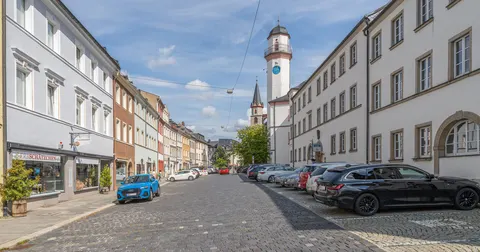
Weiden in der Oberpfalz is a district-free town in Bavaria, the second largest town in the Upper Palatinate after Regensburg. It lies about 100 kilometres east of Nuremberg, close to the Czech border. Its origins go back to a trading settlement at the crossing of two medieval routes, and the glass and porcelain works that arrived with the railway in the 19th century shaped its later growth.
Weiden, in Bavaria, Germany, is home to about 43,000 people and works as a rail hub.
Why go to Weiden?
The museums are the clearest reason to stop. The International Ceramic Museum reflects the porcelain tradition that grew up after the railway arrived. The City Museum holds art, furniture and porcelain from the Renaissance through to the 19th century, and it has a room dedicated to the composer Max Reger, who lived and studied in the town. The town's history as a trading centre is still legible in its layout, since it grew up where two major trade routes, the Goldene Strasse and the Magdeburger Strasse, crossed.
When is the best time to visit Weiden?
In July the average high reaches 23 °C; in January it is closer to 1 °C.
How do I get to Weiden without flying?
Weiden has direct train links to 6 destinations. Within 14 hours, travellers from 2,496 destinations can get here without flying. The train from Regensburg with DB Regio AG Bayern takes 53 min; that is about 1.3 kg of CO₂ per person. Nuremberg is 1h 09m away by train with DB Regio AG Bayern, with about 1.4 kg of CO₂ per person. Travelling from Bayreuth, allow 50 min by train with agilis; that is about 0.9 kg of CO₂ per person.
What to do in Weiden
International Ceramic Museum
A museum devoted to ceramics, one of two museums the town has.
City Museum
Holds art, furniture and porcelain, with a room dedicated to the composer Max Reger.