
By train
88% less CO₂Leipzig
By train from Barcelona
Route
Spain → Germany
Plan this tripPhoto: Tuxyso, CC BY-SA 3.0, Wikimedia Commons
By train in 14h 10m with 2 changes, 20 kg CO₂ per person — 88% less than the flight’s 173 kg CO₂e (door to door 6h 20m).
By train from Barcelona
By plane from Barcelona
173kg CO₂e
Per person, one way
6h20m
One way, door to door
It would take about 8 trees a full year to absorb the flight’s 173 kg CO₂e.
Only 2h20m of the 6h 20m is spent in the air.
Travel to the airport
Door to terminal
Check-in, security, boarding
Arrive early, queue, wait
Flight to Leipzig
173 kg CO₂e per trip
Travel into the city
Terminal to city centre
Arrive in Leipzig
6h20mFlight figures are CO₂e: they include the warming effect of emissions at altitude (radiative forcing). Train, bus and ferry figures are CO₂. How we calculate
By train, you can travel from Barcelona to Leipzig in 14h 10m with 2 changes, in Paris and Frankfurt. SNCF / Renfe, DB/SNCF and DB run the legs of the trip. Compared with 173 kg CO₂e for the flight, this option emits about 20 kg of CO₂ per person, 88% less. Including airport time, the flight is 7h 50m faster door to door.
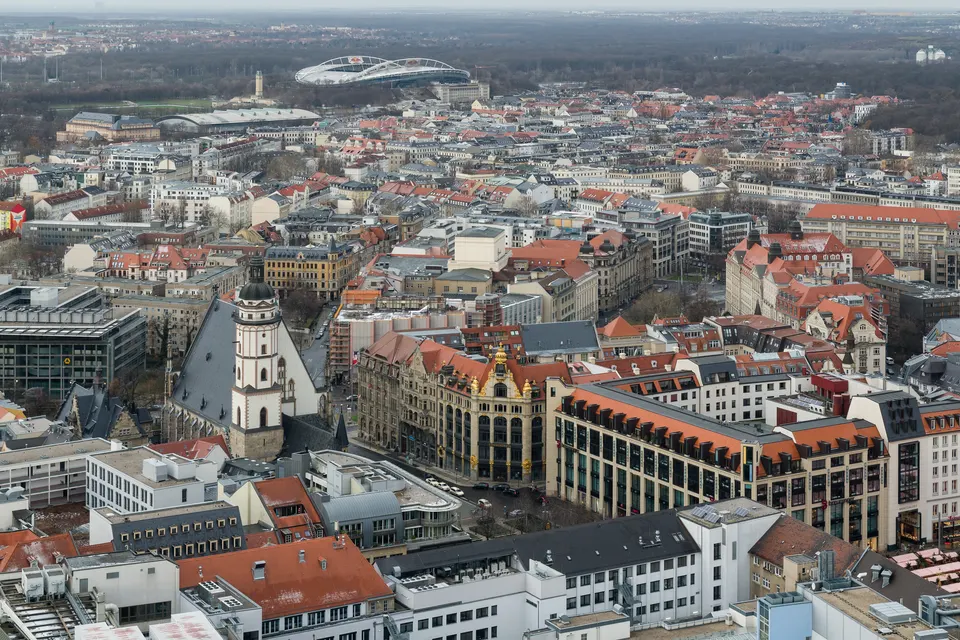
A trip built on museums and churches suits Leipzig, the most populous city in Saxony, set on the North German Plain. Its Grassi Museum and the Museum der bildenden Künste give the city a full gallery side, and the Leipzig Zoological Garden and the Leipzig Panometer offer other visits. The Johanniskirche and the Paulinerkirche are among its churches, and the Monument to the Battle of the Nations stands on its list of sights. Coming from Barcelona, a coastal city on the northeastern coast of Spain, you travel through Paris and Frankfurt, and the trip ends inland.
For city breaks in Leipzig, the best months are May, June and September, with highs of about 18 °C in May.
Going the other way? The figures here are for Barcelona to Leipzig; the trip planner searches Leipzig to Barcelona just as well, for your own dates.