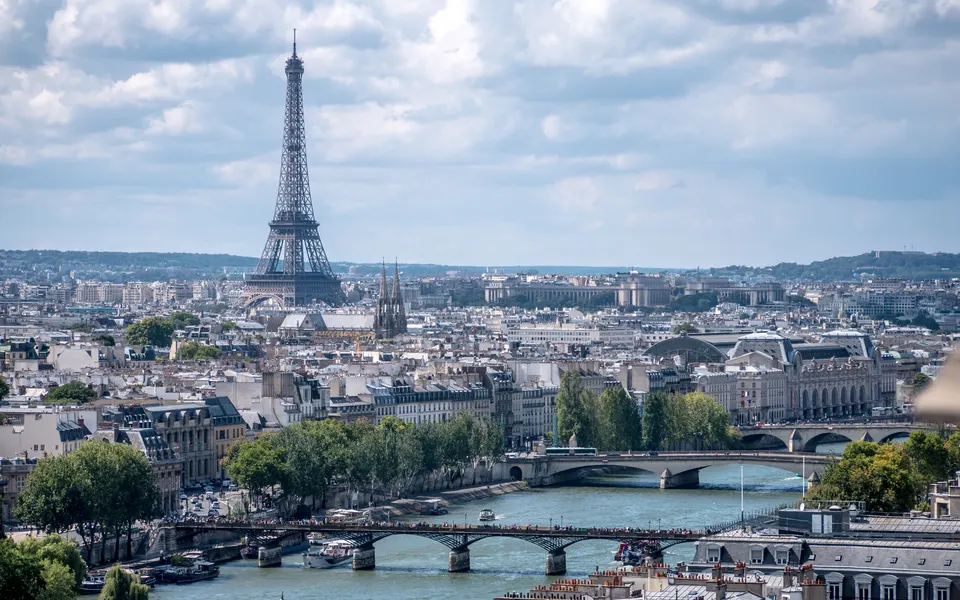

Paris is the capital and largest city of France, on the Seine in the centre of the Île-de-France region. Its twenty arrondissements each have their own identity, and the city was reshaped in the 19th century by Haussmann's broad boulevards and parks. Several United Nations bodies and European agencies are based in the city. Parts of its riverbanks are a UNESCO World Heritage Site.
About 2.1 million people live in Paris, in Île-de-France, France, and its station is a rail hub.
Why go to Paris?
Paris is known for its museums. The Louvre is the largest and most-visited museum in the world, and the Mona Lisa and the Venus de Milo are among its treasures. The Musée d'Orsay holds 19th-century and French Impressionist art, while the Musée de l'Orangerie shows most of Claude Monet's large Water Lilies murals. Modern and contemporary art fills the Musée Rodin and the Musée Picasso. The city's streets are shaped by Haussmann's boulevards, which set standard cream-grey stone facades along them, and the Art Nouveau-decorated Métro has become a symbol of Paris. Parts of the city along the Seine have been a UNESCO World Heritage Site since 1991.
When is the best time to visit Paris?
Expect daytime highs of about 24 °C in July and August, falling to 7 °C in January and December. For city breaks, any month of the year works.
How do I get to Paris without flying?
You can get to Paris without changing from 55 destinations, by train. With changes, Paris is within 14 hours of 2,374 destinations without flying. From Vienna, it takes 14h 00m by train with Nightjet, with about 14 kg of CO₂ per person against 132 kg for the flight, 89% less. Travelling from London, allow 2h 18m by train with Eurostar; that is about 2.4 kg of CO₂ per person, 95% less than the 44 kg of a flight. Brussels is 1h 22m away by train with Eurostar, with about 1.7 kg of CO₂ per person against 34 kg for the flight, 95% less.
What to do in Paris
Louvre
The largest and most-visited museum in the world, with the Mona Lisa, the Venus de Milo and Liberty Leading the People among its treasures.
Musée d'Orsay
A museum of 19th-century art and French Impressionism, one of the main museums in the city.
Musée de l'Orangerie
Near the Louvre and the Orsay, it shows Impressionist and Post-Impressionist work, including most of Claude Monet's large Water Lilies murals.
Musée Rodin
Devoted to modern and contemporary art and one of several museums dedicated to a single artist.