
By train
99% less CO₂Marseille
By train from Paris
Route
France
Plan this tripPhoto: kallerna, CC BY-SA 4.0, Wikimedia Commons
By train in 3h 04m with no changes, 1.7 kg CO₂ per person — 99% less than the flight’s 151 kg CO₂e (door to door 5h 23m).
By train from Paris
By plane from Paris
151kg CO₂e
Per person, one way
5h23m
One way, door to door
It would take about 7 trees a full year to absorb the flight’s 151 kg CO₂e.
Only 1h23m of the 5h 23m is spent in the air.
Travel to the airport
Door to terminal
Check-in, security, boarding
Arrive early, queue, wait
Flight to Marseille
151 kg CO₂e per trip
Travel into the city
Terminal to city centre
Arrive in Marseille
5h23mFlight figures are CO₂e: they include the warming effect of emissions at altitude (radiative forcing). Train, bus and ferry figures are CO₂. How we calculate
Allow 3h 04m to get from Paris to Marseille by train, with no changes. SNCF VOYAGEURS runs the service. Compared with 151 kg CO₂e for the flight, this option emits about 1.7 kg of CO₂ per person, 99% less. Counting the time at airports, you arrive 2h 19m sooner than by plane.
Cheapest train or bus fare Omio lists for this trip. The price varies with the date and changes daily.
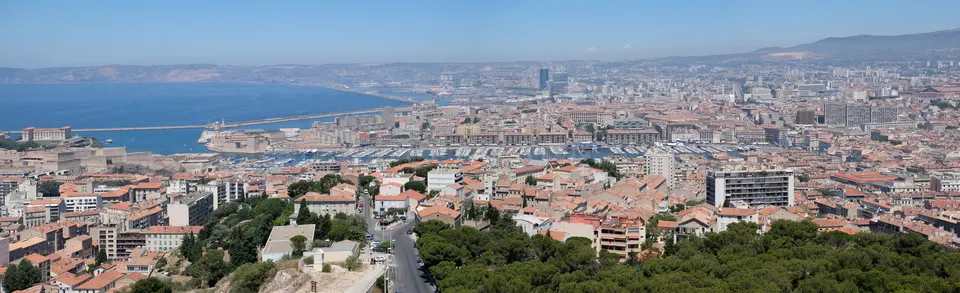
A sea-side break suits Marseille best. Set in Provence on the Mediterranean coast, the city has the Plages du Prado along its shore for anyone who wants a day by the water. Notre-Dame de la Garde rises above the port, and the Musée Cantini and the Palais du Pharo give the centre its museum stops. At the southeast edge of the city the Calanques National Park begins, so the sea is never far from the streets. Coming from Paris, on the Seine, you trade the capital's broad avenues for a southern port with a different pace and a long waterfront.
For beach holidays in Marseille, the best months are June, July and August, with highs of about 26 °C in August.
Going the other way? The figures here are for Paris to Marseille; the trip planner searches Marseille to Paris just as well, for your own dates.