
By train and bus
88% less CO₂Wroclaw
By train from Belgrade
12kg CO₂
Per person, one way
13h38m
One way, by train
Route
Serbia → Poland
Plan this tripPhoto: Hrs Poland, CC BY-SA 3.0, Wikimedia Commons
By train and bus in 13h 38m with 6 changes, 12 kg CO₂ per person — 88% less than the flight’s 96 kg CO₂e (door to door 5h 31m).
By train from Belgrade
12kg CO₂
Per person, one way
13h38m
One way, by train
By plane from Belgrade
96kg CO₂e
Per person, one way
5h31m
One way, door to door
It would take about 4 trees a full year to absorb the flight’s 96 kg CO₂e.
Only 1h31m of the 5h 31m is spent in the air.
Travel to the airport
Door to terminal
Check-in, security, boarding
Arrive early, queue, wait
Flight to Wroclaw
96 kg CO₂e per trip
Travel into the city
Terminal to city centre
Arrive in Wroclaw
5h31mFlight figures are CO₂e: they include the warming effect of emissions at altitude (radiative forcing). Train, bus and ferry figures are CO₂. How we calculate
Going from Belgrade to Wroclaw by train and bus takes 13h 38m, with 6 changes. The trip is run by Srbija Voz, Železničná spoločnosť Slovensko, a.s. and MAV, among others. Per person, the trip produces about 12 kg of CO₂ against 96 kg CO₂e by air, a saving of 88%. Allow 8h 07m more than the flight, door to door.
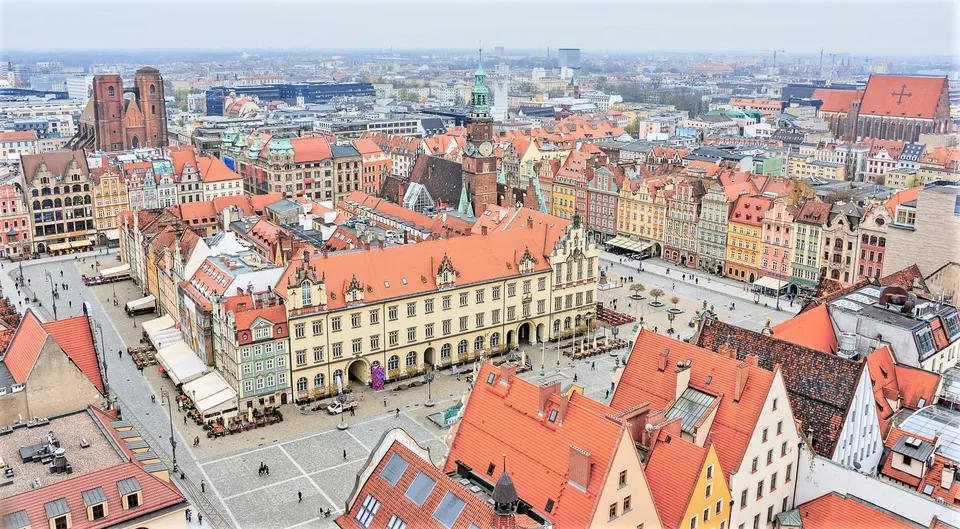
The Centennial Hall is a UNESCO World Heritage Site, and it is one of the sights that show how the city presents itself as a regional capital. Wrocław Cathedral and the Wrocław Town Hall stand among its churches and public buildings, and the Racławice Panorama adds a panorama to its sights. The city stands on the banks of the Oder, in the Silesian Lowlands. Coming from Belgrade, the Serbian capital where the Sava and Danube rivers meet, you travel north through Bratislava, and the trip ends in a Polish city on the Oder.
Plan city breaks in Wroclaw for May, June and September, when May reaches about 19 °C.
Going the other way? The figures here are for Belgrade to Wroclaw; the trip planner searches Wroclaw to Belgrade just as well, for your own dates.