
By train
88% less CO₂Ghent
By train from Wiesbaden
Route
Germany → Belgium
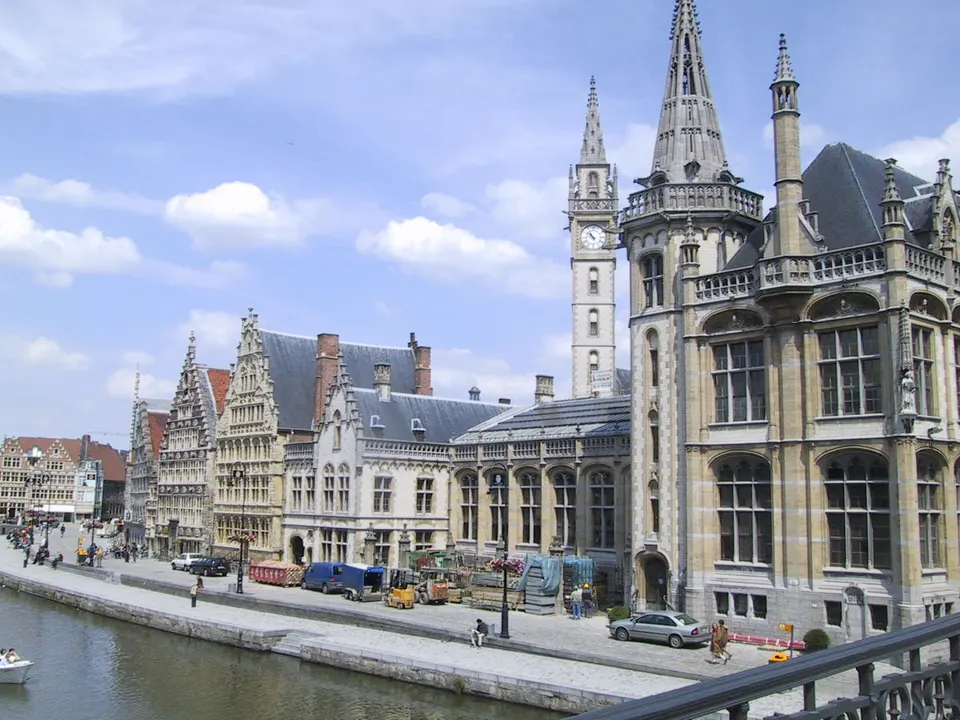
Plan this tripPhoto: Unknown, CC BY-SA 3.0, Wikimedia Commons
By train in 4h 01m with 2 changes, 5.3 kg CO₂ per person — 88% less than the flight’s 43 kg CO₂e (door to door 4h 58m).
By train from Wiesbaden
By plane from Wiesbaden
43kg CO₂e
Per person, one way
4h58m
One way, door to door
It would take about 2 trees a full year to absorb the flight’s 43 kg CO₂e.
Only 58m of the 4h 58m is spent in the air.
Travel to the airport
Door to terminal
Check-in, security, boarding
Arrive early, queue, wait
Flight to Ghent
43 kg CO₂e per trip
Travel into the city
Terminal to city centre
Arrive in Ghent
4h58mFlight figures are CO₂e: they include the warming effect of emissions at altitude (radiative forcing). Train, bus and ferry figures are CO₂. How we calculate
Allow 4h 01m to get from Wiesbaden to Ghent by train, with 2 changes, in Cologne and Brussels. You travel with DB Fernverkehr AG, Eurostar and NMBS/SNCB. That emits about 5.3 kg of CO₂ per person, 88% less than the flight's 43 kg CO₂e. Once check-in and airport transfers are included, it beats the flight by 57 min.
Ghent is a port city and a university city, and its contrast is between the old quarter with its belfry and castle and the wider city around it. The Belfry of Ghent and the Gravensteen anchor the historic core, and the Museum of Fine Arts sits within reach. The Prinsenhof adds an older layer to the centre. Coming from Wiesbaden, the state capital of Hesse in the Rhine-Main region, the route runs through Cologne and Brussels before the final stretch into East Flanders, where the castle and the belfry wait.
For city breaks, Ghent works in any month of the year.
Going the other way? The figures here are for Wiesbaden to Ghent; the trip planner searches Ghent to Wiesbaden just as well, for your own dates.