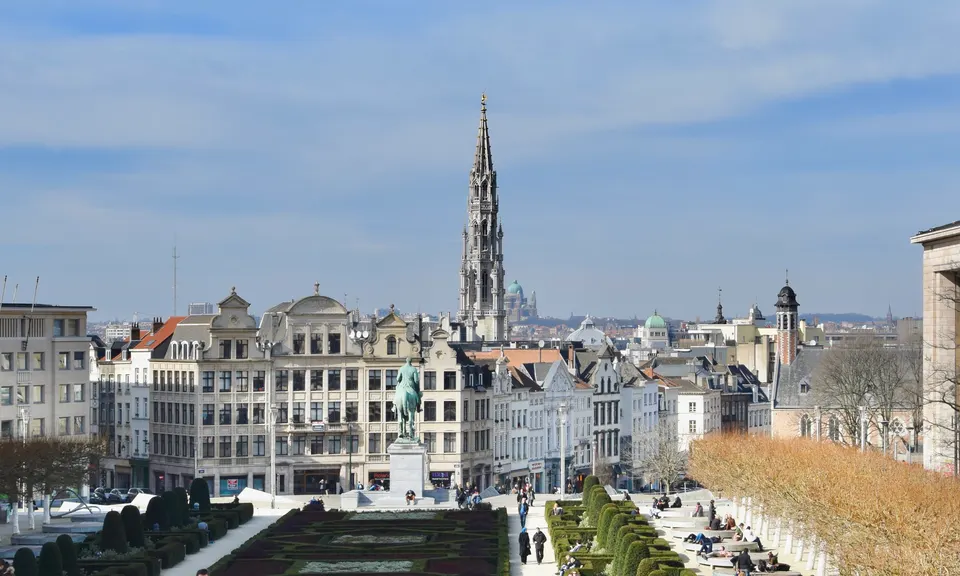

Brussels is a patchwork of old centre and newer districts, where the architecture, the language and the food all show the mix of influences that shaped the city. As the capital of Belgium, it also hosts many of the principal institutions of the European Union in its European Quarter. Walk through the centre and you soon reach the Grand-Place, a square framed by old façades that catches the late light, with the Royal Palace of Brussels a short walk away. The city has the easy confidence of a capital that is used to visitors from many countries.
About 1 million people live in Brussels, in Brussels Capital, Belgium, and its station is a rail hub.
Why go to Brussels?
Brussels is a city where you can plan a day around one square and still find plenty to see. The Grand-Place is the heart of the old town, and the Cathedral of St. Michael and St. Gudula stands close by. Museums are a big draw: the Royal Museums of Fine Arts of Belgium hold a broad collection, while the Belgian Comic Strip Center and the Horta Museum offer more focused visits. Mini-Europe and the Cinquantenaire Park suit a family afternoon, and the House of European History gives a clear account of the continent's shared story. Brussels is also a good place to see the Major Town Houses of the Architect Victor Horta, a UNESCO World Heritage Site. End the day at a café on a side street and let the evening set the pace.
When is the best time to visit Brussels?
Expect daytime highs of about 22 °C in July and August, falling to 6 °C in January and December. For city breaks, any month of the year works.
How do I get to Brussels without flying?
You can get to Brussels without changing from 46 destinations, by bus or train. With changes, Brussels is within 14 hours of 2,358 destinations without flying. From Vienna, it takes 14h 00m by train with Nightjet, with about 12 kg of CO₂ per person against 117 kg for the flight, 90% less. Travelling from Paris, allow 1h 22m by train with Eurostar; that is about 1.7 kg of CO₂ per person, 95% less than the 34 kg of a flight. Cologne is 1h 50m away by train with Eurostar, with about 2.5 kg of CO₂ per person against 23 kg for the flight, 89% less.
What to do in Brussels
Grand-Place
Start at the Grand-Place, a UNESCO World Heritage Site and the heart of the old town. Sit at a café on the edge of the square and watch the façades change colour as the light moves across them.
Royal Museums of Fine Arts of Belgium
The Royal Museums of Fine Arts of Belgium hold a wide range of paintings, with rooms that reward a slow walk. Allow a few hours and pick one period to focus on so the visit does not feel rushed.
Find tours and tickets: Royal Museums of Fine Arts of Belgium
Mini-Europe
Mini-Europe is a miniature park with scale models of landmarks from across the continent, a playful choice for a family afternoon. Pair it with a stroll through the nearby Cinquantenaire Park.
House of European History
The House of European History tells the story of the continent through a series of exhibitions. It makes a useful counterpoint to the old squares around the Grand-Place and the European Quarter.