By Thomas AxelssonPublished Updated 4 min read
Sustainate lists 478 destinations in France, and 333 of them are connected to the route network, plus 697 domestic routes and 205 that cross a border. Paris alone has 55 direct links, and the London to Paris Eurostar takes 2h 18m while emitting 2.4 kg of CO₂ against 44 kg for the flight.
How do you get around France without flying?
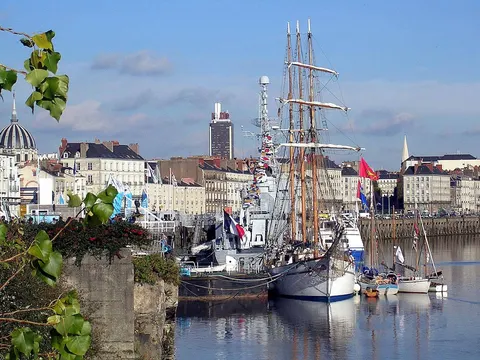
Paris is the natural starting point, with a train in every direction. From there the rest of the country opens up in a day or less. Nantes is 1h 58m away by SNCF VOYAGEURS at 0.9 kg of CO₂, against 79 kg for the flight, a saving of 99%. Bordeaux takes 2h 03m at 1.3 kg, against 114 kg by air.
Some links reach deep into Europe's wider network. The Paris to Vienna Nightjet takes 14h 00m and emits 14 kg against 132 kg for the flight, a saving of 89%. Paris to Brussels on Eurostar takes 1h 22m and emits 1.7 kg against 34 kg.
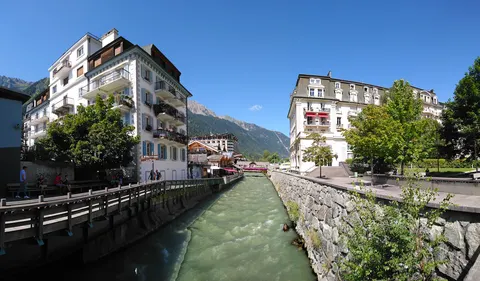
Buses fill in where trains do not, and the savings stay large even on long rides. The FlixBus from Chamonix-Mont-Blanc to Dijon takes 3h 55m and emits 5.6 kg over 209 km, against 48 kg for the flight, a saving of 88%. Nantes to Bordeaux is a 240-minute SNCF train at 5 kg against 63 kg.
How well connected are the main French destinations?
The table lines up five destinations by direct links and by how far a day takes you.
| Destination | direct links | reach in eight hours | reach in fourteen hours |
|---|---|---|---|
| Paris | 55 | 1,463 | 2,374 |
| Bordeaux | 25 | 1,010 | 2,076 |
| Nantes | 10 | 968 | 2,019 |
| Chamonix-Mont-Blanc | 9 | 700 | 2,119 |
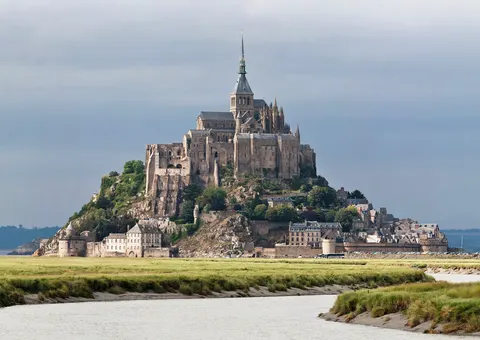
| Mont-Saint-Michel | 2 | 625 | 1,833 |
Paris has trains to Vienna and Brussels among others. From the capital, 1,463 destinations lie within eight hours and 2,374 within fourteen, a good measure of how far one day reaches. Bordeaux has 25 links by bus and train: Toulouse is 2h 21m away at 0.5 kg over 212 km, Nantes 4h 00m, and Paris 2h 03m. Nantes has 10 links, including Angers in 37 minutes at 0.2 kg over 80 km.
The small places show the other end. Mont-Saint-Michel has two links, both by Keolis Armor bus: Rennes in 1h 15m at 1.6 kg over 59 km, and Saint-Malo in 1h 18m at 1 kg over 37 km. Yet it still reaches 625 destinations within eight hours. Chamonix-Mont-Blanc has nine links, with buses to Geneva in 1h 10m and to Courmayeur in 50 minutes by BlaBlaCar Bus.
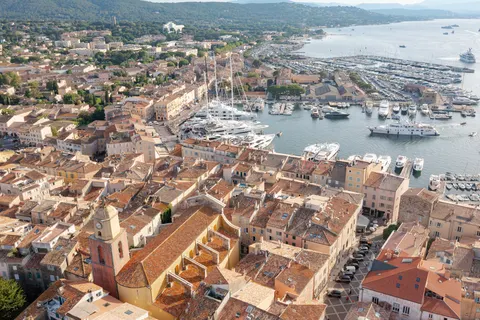
Saint-Tropez is a different case: Sustainate has no direct links for it, so it is not part of the route network. Plan around a nearby hub rather than expecting a through ticket.
Which trips cross the border from France?
France has 205 international routes, to Andorra, Austria, Belgium, Germany, Italy, Luxembourg, Monaco, the Netherlands, Spain, Switzerland and the United Kingdom. Four crossings show the range, each with its time and CO₂.
- London to Paris, from the United Kingdom: a 138-minute Eurostar, emitting 2.4 kg of CO₂ against 44 kg for the flight, and 2h 40m faster door to door than flying.
- Berlin to Paris, from Germany: a 495-minute train with one change on DB Fernverkehr AG and DB/SNCF, emitting 12 kg against 112 kg, a saving of 89%. The night option takes 13h 00m with European Sleeper, DB Fernverkehr AG and Eurostar, and emits 11 kg.
- Madrid to Paris, from Spain: a 591-minute train, emitting 17 kg of CO₂ against 135 kg for the flight, a saving of 87%.
- Chamonix-Mont-Blanc to Geneva, in Switzerland: a 70-minute FlixBus-eu ride, emitting 1.7 kg over 64 km.
Which month suits each kind of trip in France?
Each kind of trip has its own season. The counts show how many destinations qualify in the best month:
- Nature & Hiking: June, with 137 destinations.
- City & Culture: May, with 100 destinations.
- Snow & Ski: January, with 93 destinations.
- Sun & Beach: August, with 92 destinations.
For city breaks, May is the peak month for Paris and Nantes, at 18 °C in each. Bordeaux is the exception, with October first at 19 °C. Chamonix-Mont-Blanc peaks for skiing in January at 1 °C and for hiking in June at 19 °C. Saint-Tropez peaks for beach days in July at 27 °C. Snow & Ski has 93 destinations in January, against 137 for Nature & Hiking in June, so summer offers France's wider choice. It is warm too: Paris reaches 24 °C in July and August, Bordeaux 26 °C in both, and Nantes 24 °C in August.
How much CO₂ does going by train save?
The table sets the long routes into France against the flight, with the train's time and emissions.
| Route | train time | train CO₂ | flight CO₂ | saved |
|---|---|---|---|---|
| London to Paris | 2h 18m | 2.4 kg | 44 kg | 95% |
| London to Lyon | 4h 34m | 3.4 kg | 94 kg | 96% |
| London to Marseille | 5h 42m | 4.1 kg | 128 kg | 97% |
| Madrid to Paris | 9h 51m | 17 kg | 135 kg | 87% |
| Berlin to Paris | 8h 15m | 12 kg | 112 kg | 89% |
The London trains save 42 kg on London to Paris and 124 kg on London to Marseille. London to Paris beats the flight door to door by 2h 40m, and London to Marseille beats it by just 9 minutes. Berlin to Paris goes the other way, 2h 34m slower than flying. Trips from Spain follow the same pattern, with long hours on board and a very small carbon bill: Seville to Bordeaux takes 12h 29m and emits 17 kg against 121 kg for the flight. The method behind these figures is on the methodology page.