By Thomas AxelssonPublished Updated 4 min read
Istanbul to Sofia is a single train with no change, so the planning is about the time of day you travel and whether you want the night option. For times, changes and CO₂ against the flight, see the Istanbul to Sofia route guide.
Is there a change on the Istanbul to Sofia train?
There is no change. The route data lists one direct train, run by BDZ/TCDD, and it takes 10h 00m. You board in Istanbul and arrive in Sofia without a connection to protect.
That removes the usual planning risk, but it leaves a long single ride. Since the data gives a running time and not a timetable, check the departures for your date before you build a day around it.
Is there a night option?
Yes. The route data lists a night option that takes 11h 00m, which is 1h 00m longer than the daytime train, and it is run by the same BDZ/TCDD pairing. It emits 15 kg of CO₂, against 12 kg for the daytime train.
The night option turns the trip into a way of covering the distance while you sleep, if that suits you. The data does not describe the service, so it holds nothing on berths or boarding, and you would need to check what is offered for your date. The extra hour is the only difference in time that the data records.
How does the train compare with the flight on time?
The train is slower. The flight takes 5h 11m door to door once airport time is added, and the train is 289 minutes behind it. That is a long gap, so this is a trip you choose for the way you travel, not for speed.
The footprint is the case for the train: it emits 12 kg of CO₂ against 65 kg for the flight, a saving of 53 kg or 82%. The CO₂ methodology page explains how the figures are worked out.
When is the best time to visit Sofia?
May comes first for a City & Culture trip, with an average daily high of 20 °C. October follows, then April and September. July and August are the warmest months at 26 °C, and January is the coldest at 4 °C.
| Month | average high |
|---|---|
| January | 4 °C |
| February | 6 °C |
| March | 10 °C |
| April | 16 °C |
| May | 20 °C |
| June | 24 °C |
| July | 26 °C |
| August | 26 °C |
| September | 22 °C |
| October | 17 °C |
| November | 10 °C |
| December | 5 °C |
Istanbul runs a little warmer in summer, reaching 27 °C in August against 26 °C in Sofia, and a little milder in winter, with 8 °C in January against 4 °C. For a spring or early summer trip, see the ideas page for a city break in May.
What is there to see in Sofia?
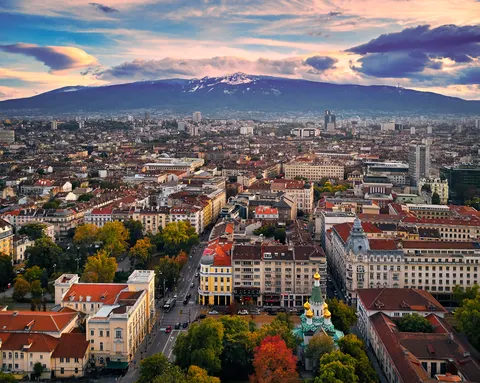
Churches and museums fill the list. Alexander Nevsky Cathedral, Saint Sophia Church, Saint Nedelya Church and the Saint George Rotunda Church are the churches in the data. The National Archaeological Museum and the National Art Gallery of Bulgaria are the museums.
Boyana Church is a UNESCO site, 7.5 km from the centre, so it is the one place that needs a little more planning than the rest. After a ride of 10h 00m, the churches in the centre are an easy way to spend the first evening.
What can you see in Istanbul before you leave?
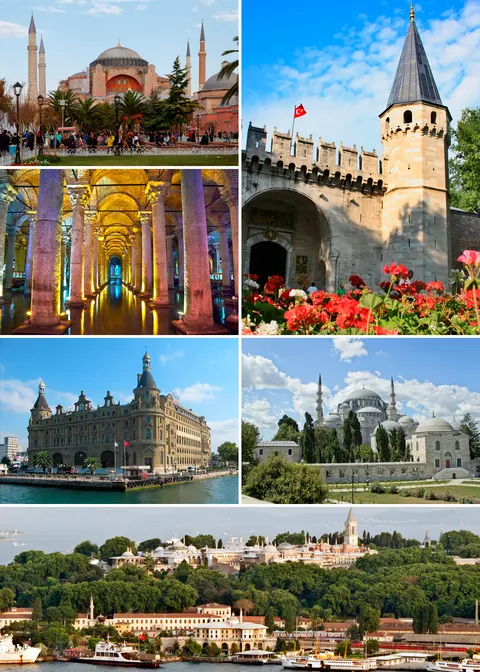
If your train departs later in the day, the sights listed for Istanbul fill a morning. Hagia Sophia, Topkapı Palace and the Golden Horn are the landmarks, and the Historic Areas of Istanbul is a UNESCO site 0.1 km from the centre. Galata Tower, Dolmabahçe Palace and Maiden's Tower are listed as nearby sights.
How do you choose between the day and night train?
The two options differ by 1h 00m, and they run the same direct route. The choice is mostly about when you want to arrive. The daytime train covers 10h 00m in one stretch, which fills a day, while the night option stretches to 11h 00m and moves the ride into the hours you would otherwise be asleep.
If you are travelling in the cold months, remember the weather at the other end. Sofia averages 4 °C in January and 6 °C in February, so you arrive somewhere much cooler than Istanbul's 8 °C. From April, at 16 °C, the arrival is easier, and in May it reaches 20 °C.
Where can you go on from Istanbul?
Istanbul has fewer onward options than Sofia, but the ones it lists are direct. Ankara takes 4h 30m by train, run by TCDD, and Bucharest takes 18h 00m, run by CFR/TCDD. If you want a second city on the trip, Sofia is the practical one at 10h 00m, and from there the list above takes over.
Where can you go on from Sofia?
Sofia is a rail hub with 16 direct links by bus and train. It reaches 80 destinations within eight hours and 250 within fourteen. Istanbul has 13 direct links and reaches 63 within eight hours and 158 within fourteen.
From Sofia, these onward options are in the data:
- Veliko Tŭrnovo takes 3h 10m by bus, run by FlixBus-eu.
- Thessaloniki takes 4h 40m by bus, run by FlixBus-eu.
- Varna takes 7h 30m by train, run by BDZ.
- Belgrade takes 9h 00m by train, run by BDZ/SV.
- Bucharest takes 9h 30m by train, run by BDZ/CFR.
For longer trips that end in Sofia, the route guides cover Belgrade to Sofia and Budapest to Sofia. The way home uses the same direct train in the other direction.