By Thomas AxelssonPublished Updated 4 min read
The train from London to Frankfurt is a trip in two parts with one change, and most of the planning comes down to that change. For times, changes and CO₂ against the flight, see the London to Frankfurt route guide.
Where do you change between London and Frankfurt?
The change is in Brussels. You ride from London to Brussels first, then take a second train on to Frankfurt. The route data lists no direct service, so plan on two trains rather than one.
Two operators share the work. Eurostar runs the first leg to Brussels, which takes 1h 57m. DB runs the second leg to Frankfurt, which takes 3h 00m. Those two legs add up to the 5h 17m ride, and the whole trip comes in 5 minutes quicker than the flight door to door.
Because the legs belong to different operators, treat the change as a real step in the plan, not an afterthought. Leave a comfortable gap in Brussels before the second train, so a late arrival from London does not cost you the connection. The route guide shows the total, so you can judge how much slack your day has.
What does the change mean for planning?
The practical effect is that you are building two journeys that happen to meet in Brussels. A few habits follow from that.
- Check the departure times for both legs before you commit to either one.
- Choose a Brussels connection with room to spare, not the tightest one on offer.
- Keep your onward plans in Frankfurt loose on the day of travel, since the second leg sets your arrival time.
The Brussels change also gives you a built-in rest point. London to Brussels takes just under two hours, and the longer ride to Frankfurt comes after it, so the trip splits into a short first half and a longer second one.
When is the best time to go to Frankfurt?
For a City & Culture trip, May comes first, with an average daily high of 19 °C. September follows, then June, April and October. If you want warmth, July and August are the warmest months in Frankfurt, both at 24 °C, while January is the coldest at 4 °C.
| Month | average high |
|---|---|
| January | 4 °C |
| February | 6 °C |
| March | 10 °C |
| April | 14 °C |
| May | 19 °C |
| June | 22 °C |
| July | 24 °C |
| August | 24 °C |
| September | 20 °C |
| October | 14 °C |
| November | 8 °C |
| December | 5 °C |
You are starting from London, where the average high in June is 19 °C and in July 21 °C, so Frankfurt is a few degrees warmer in summer. For a city break in May, the figures favour Frankfurt at 19 °C.
What is there to see in Frankfurt?
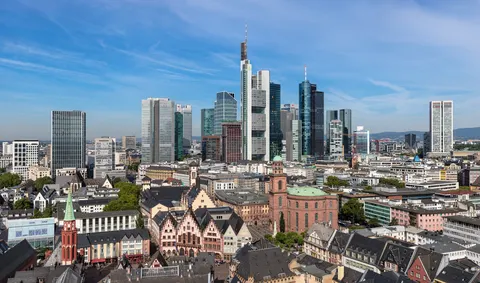
The sights in the data lean towards museums and old churches. The Städel Museum, the Senckenberg Museum and Goethe House are the museums listed. Frankfurt Cathedral and St. Paul's Church, Frankfurt am Main are the churches, and the Altstadt is the old town.
Frankfurt has no UNESCO sites in the data, so these listed sights are the anchor for a first visit. If you arrive after the 5h 17m ride, pick one or two close to the centre and leave the rest for another trip.
Frankfurt is also a good base for short rail hops. From there, Cologne is 1h 05m away by train, Leipzig 3h 00m, Munich 3h 30m and Paris 4h 00m. Berlin takes 3h 55m, and Vienna is 6h 30m.
Can you do the trip in reverse, or carry on from Frankfurt?
Yes. Frankfurt is a rail hub with 41 direct links by bus and train, and it reaches 1,423 destinations within eight hours and 2,596 within fourteen. That is more than London, which reaches 1,079 within eight hours and 2,035 within fourteen, so Frankfurt is the stronger base for onward travel.
If you would rather head home through Brussels, the same two legs apply in the other direction. Allow the same buffer at the change, and plan the day around the longer DB leg first.
Other trips that start in Frankfurt are covered in the route guides for Berlin to Frankfurt, Paris to Frankfurt and Rome to Frankfurt. For the full picture of how the CO₂ figures are worked out, see how Sustainate calculates CO₂.
What is within reach of Frankfurt for a day?
Several towns sit close enough to treat as side trips. Darmstadt is 27 km from Frankfurt, Wiesbaden 32 km and Mainz 34 km. Hanau am Main and Erzhausen are both 17 km away, and Rüsselsheim am Main is 23 km. The route data does not list rail times for these, so check the connections for your date before you plan a day around one.
If you prefer to keep the whole stay in the city, the museums and the Altstadt are enough to fill a weekend. The cold months suit the museums best, with the average high at 4 °C in January and 6 °C in February. In late spring, when the high reaches 19 °C in May, walking the Altstadt and the area around Frankfurt Cathedral becomes the easier choice.
What can you do in London before you leave?
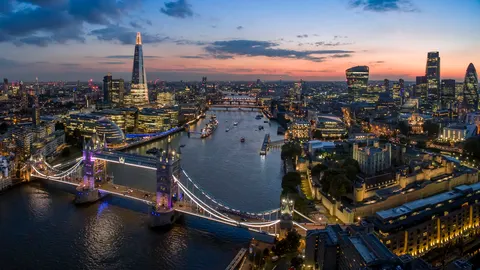
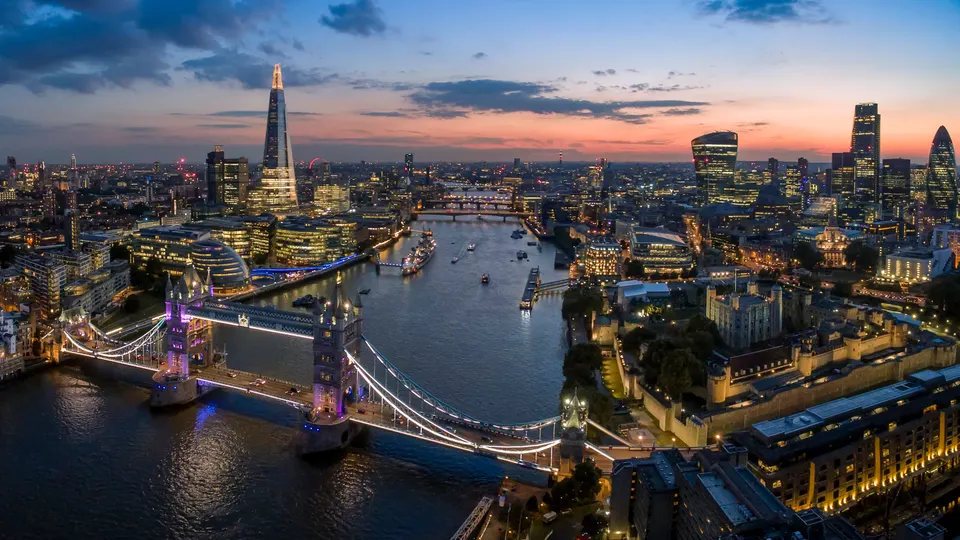
If your train leaves later in the day, the sights listed for London are close to the centre. London Bridge and St Paul's Cathedral are the landmarks, and the Palace of Westminster and Westminster Abbey including Saint Margaret's Church is 0.8 km from the centre, with the Tower of London 3.6 km away. Buckingham Palace, Westminster Abbey and the British Museum are listed as nearby sights.
Starting from London opens its own options. Paris is 2h 18m away on Eurostar, Brussels 1h 57m and Amsterdam 4h 00m. If you want to see more than one city on the way, Brussels is the obvious place to stop, since you pass through it anyway.