By Thomas AxelssonPublished Updated 4 min read
Budapest to Munich goes through Vienna, so this trip is a long ride split in two with one change in the middle. For times, changes and CO₂ against the flight, see the Budapest to Munich route guide.
Where is the change on the Budapest to Munich train?
The change is in Vienna. You ride from Budapest to Vienna first, then continue to Munich. The route data lists no direct train for the pair.
Two operators share the legs. ÖBB/MAV runs Budapest to Vienna, which takes 2h 30m, and ÖBB runs Vienna to Munich, which takes 4h 00m. The short leg comes first and the long one second, so you arrive in Vienna with most of the trip still ahead of you. Leave a gap that suits you at the change, not the tightest one on offer, and check the departures for both legs before you plan the day.
How should you split the day?
Think of the trip as a short block followed by a long one. Budapest to Vienna takes 2h 30m, and Vienna to Munich takes 4h 00m. A morning start from Budapest puts the change around midday, and the longer ÖBB leg fills the afternoon. A later start pushes your arrival in Munich into the evening, so decide first how much of your first day in Munich you want.
Because the second leg is the longer one, the Vienna change sets your arrival more than the first departure does. Pick the Vienna departure you want, then choose the Budapest train that reaches it with room to spare. The reverse trip uses the same legs in the opposite order: the long ÖBB ride first, then the shorter ÖBB/MAV leg into Budapest.
Is the train slower than flying?
Yes, by a fair amount. The flight takes 5h 16m door to door once airport time is added, and the train is 94 minutes behind it. The route data puts the whole trip at 6h 50m.
That gap is the cost of the change, and it is worth knowing before you decide. The reason to take the train is the footprint: the route guide compares the CO₂ with the flight. The reason to plan carefully is the same as with any trip that has a change, which is that a late first leg can shift your whole day.
When is the best time to visit Munich?
May comes first for a City & Culture trip, with an average daily high of 18 °C. September follows, then June, August and July. July is the warmest month at 23 °C, and January is the coldest at 3 °C.
| Month | average high |
|---|---|
| January | 3 °C |
| February | 5 °C |
| March | 9 °C |
| April | 13 °C |
| May | 18 °C |
| June | 20 °C |
| July | 23 °C |
| August | 22 °C |
| September | 18 °C |
| October | 14 °C |
| November | 7 °C |
| December | 4 °C |
Budapest is warmer in summer, with 26 °C in July and August, so you will step into a cooler Munich if you travel then. In winter Budapest drops to 2 °C in January, a degree below Munich. If the month is flexible, a city break in May matches the peak for both cities.
What is there to see in Munich?
The list is mostly museums. The Deutsches Museum, the Alte Pinakothek, the Neue Pinakothek and the Glyptothek are in the data, along with the Frauenkirche and the Englischer Garten. Munich has no UNESCO sites listed, so the museums are the anchor for a stay.
After a ride of 6h 50m, a park is an easy place to start, and the Englischer Garten fits that. Keep the museums for a full day, since four of them are listed. The Frauenkirche is the church in the list, and it makes an easy short stop between museums.
If you travel in the cooler months, the museums are the better choice, because the average high is only 3 °C in January and 5 °C in February. From April, at 13 °C, the park becomes the easier option, and by May, at 18 °C, you can spend most of the day outdoors.
What can you see in Budapest before you leave?
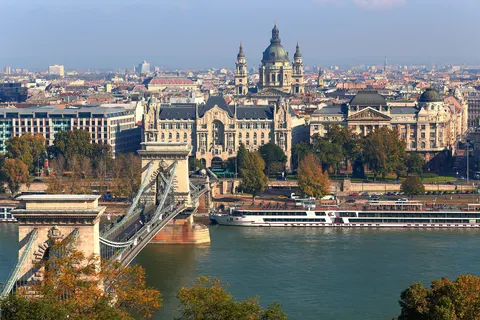
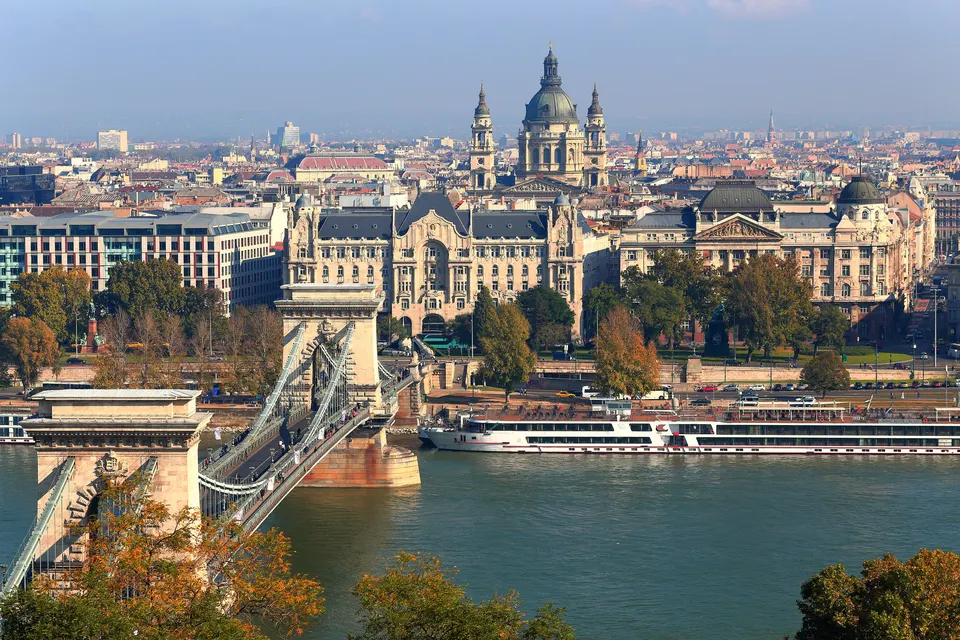
If your train departs later in the day, Budapest's listed sights give you a morning. The Széchenyi Chain Bridge, St. Stephen's Basilica and Matthias Church are the landmarks. Buda Castle is a UNESCO site 0.2 km from the centre, and Andrássy út is another, 2.7 km away.
Where can you go on from Budapest?
Budapest has a different set of onward options from Munich's. Belgrade takes 8h 00m by train, run by SV/MAV, and Bucharest takes 15h 00m, run by CFR/MAV. Both are long, so if you want to add a second city to the trip, Vienna is the only short hop in the data at 2h 30m.
Where can you go on from Munich?
Munich is a rail hub with 52 direct links by bus and train. It reaches 1,436 destinations within eight hours and 2,681 within fourteen. Budapest has 15 direct links and reaches 454 within eight hours and 1,774 within fourteen. Munich is the stronger base for onward travel.
From Munich, these onward options are in the data:
- Frankfurt takes 3h 30m by train, run by DB.
- Berlin takes 4h 00m by train, run by DB.
- Vienna takes 4h 00m by train, run by ÖBB.
- Prague takes 4h 46m by bus, run by FlixBus-eu.
- Garmisch-Partenkirchen takes 1h 11m by bus, run by FlixBus-eu.
For longer trips that end in Munich, the route guides cover Berlin to Munich, Paris to Munich, Hamburg to Munich and London to Munich.