By Thomas AxelssonPublished Updated 4 min read
September suits nature and hiking in 950 destinations, and this guide picks eight of them. Each has an average daily high of 18 or 19 °C that month and at least one direct train or bus link.
Which nature and hiking destinations suit September?
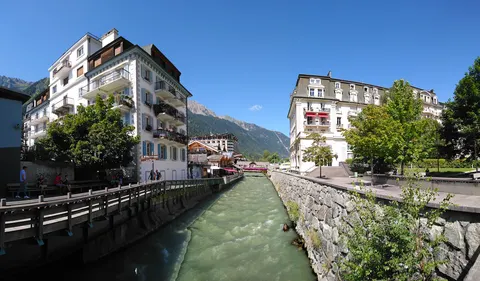
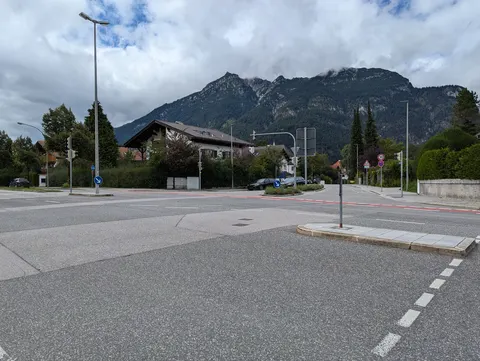
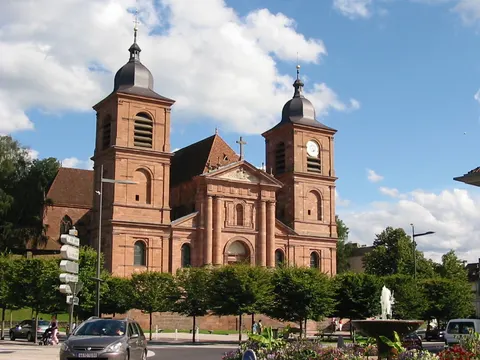
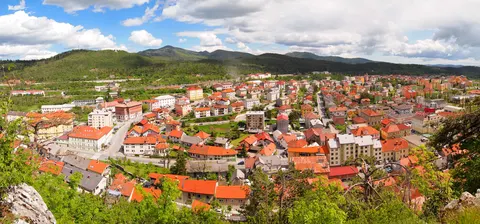
The eight places are spread over five countries. Chamonix-Mont-Blanc and Saint-Dié-des-Vosges are in France, Garmisch-Partenkirchen and Berchtesgaden in Germany, Interlaken and Thun in Switzerland, Kufstein in Austria and Postojna in Slovenia. Seven are rail hubs, and Postojna is the one that is not.
These are not only walking places. Five also carry a City & Culture label: Garmisch-Partenkirchen, Berchtesgaden, Saint-Dié-des-Vosges, Thun and Kufstein. Chamonix-Mont-Blanc, Interlaken and Garmisch-Partenkirchen carry Snow & Ski as well.
What is the weather like in September?
Gentle, and strikingly similar from one town to the next. The table sets September beside each place's warmest and coldest month, using average daily highs.
| destination | September | warmest month | coldest month |
|---|---|---|---|
| Chamonix-Mont-Blanc | 18 °C | 22 °C | 1 °C |
| Interlaken | 19 °C | 23 °C | 4 °C |
| Garmisch-Partenkirchen | 18 °C | 22 °C | 2 °C |
| Berchtesgaden | 19 °C | 23 °C | 2 °C |
| Saint-Dié-des-Vosges | 19 °C | 23 °C | 4 °C |
| Thun | 19 °C | 23 °C | 4 °C |
| Postojna | 19 °C | 24 °C | 3 °C |
| Kufstein | 19 °C | 23 °C | 3 °C |
Five of the eight put September first for nature and hiking: Interlaken, Berchtesgaden, Saint-Dié-des-Vosges, Thun and Postojna. For Chamonix-Mont-Blanc and Garmisch-Partenkirchen, June comes first and September second, and for Kufstein it is May first. The warmest month is July at most places, with Postojna reaching 24 °C in July and August. January or December is the coldest, with highs between 1 and 4 °C.
Because the September figures sit so close together, the links are a better guide than the weather when you choose between these places.
Which of these places is easiest to reach by train?
Start with the number of direct links. Chamonix-Mont-Blanc has nine, Interlaken and Kufstein eight each, and Garmisch-Partenkirchen seven. At the other end, Postojna has one: an 18-minute train to Divača run by Slovenske zeleznice.
The table sets each place's links beside the number of destinations it reaches within eight and fourteen hours.
| destination | direct links | reach in eight hours | reach in fourteen hours |
|---|---|---|---|
| Chamonix-Mont-Blanc | 9 | 700 | 2119 |
| Interlaken | 8 | 809 | 2233 |
| Garmisch-Partenkirchen | 7 | 914 | 2551 |
| Berchtesgaden | 2 | 720 | 2420 |
| Saint-Dié-des-Vosges | 2 | 1089 | 2253 |
| Thun | 6 | 952 | 2290 |
| Postojna | 1 | 247 | 1622 |
| Kufstein | 8 | 1010 | 2622 |
From Chamonix-Mont-Blanc, the FlixBus-eu buses run to Dijon in 3h 55m and Geneva in 1h 10m, and BlaBlaCar Bus reaches Courmayeur in 50 minutes. From Garmisch-Partenkirchen, FlixBus-eu buses take 1h 11m to Munich, 1h 05m to Innsbruck and 3h 59m to Trento.
Interlaken's listed links are short. Lauterbrunnen is a 10-minute bus, Grindelwald a 20-minute train and Bern a 60-minute train. Thun is closer still to Bern, at 19 minutes, with Muri 17 minutes away and Spiez 8.
Saint-Dié-des-Vosges has two direct links, both by SNCF VOYAGEURS train, to Nancy in 55 minutes and Mutzig in 1h 03m. Even so, it reaches 1089 destinations within eight hours, which shows that a quiet station can still sit well inside the network. Berchtesgaden also has two links, a 9-minute train to Bischofswiesen and an 18-minute bus to Schönau am Königssee.
Kufstein reaches 1010 destinations in eight hours and 2622 in fourteen, the highest figure in either column. Postojna manages 247 in eight hours, the lowest. A longer day tells a different story from the link count. Links show how many routes start at a place, and reach shows how far a day can take you, so it helps to read both before you pick a place to stay.
How much CO₂ do these trips save compared with flying?
Only two of these routes come with a flight to compare against. The bus from Chamonix-Mont-Blanc to Dijon covers 209 km and emits 5.6 kg of CO₂, against 48 kg for the flight, a saving of 88%. The bus from Garmisch-Partenkirchen to Trento covers 158 km and emits 4.3 kg, against 20 kg, a saving of 79%.
The other links have no flight figure, so there is no percentage for them. Their own emissions are small all the same. Kufstein to Salzburg emits 0.5 kg over 71 km, Kufstein to Munich 0.9 kg over 75 km, and Postojna to Divača 0.2 kg over 22 km. The method behind all these figures is on the methodology page.
What else is worth knowing before you go?
Berchtesgaden and Postojna each depend on very few direct links, so confirm those connections before you commit to either. Timetables change, so check the times for your travel date rather than relying on a figure from this page.
Kufstein suits a trip that crosses borders, since its listed trains go to Munich in Germany as well as to Salzburg and Wörgl in Austria. Garmisch-Partenkirchen's buses run into Austria and Italy. If you are building a trip around one of these places, start from its rail hub and work outwards, because the links from that hub decide how the day is shaped.
Two practical points follow from the data. First, at the three places where June or May ranks ahead of September, September is a close second rather than a compromise on weather. Second, the average highs are for the town itself. Higher ground nearby will be cooler, and the route data says nothing about trails or huts, so check those separately once you know where you are staying.
A sensible pairing is a base with good reach and a short hop to somewhere quieter. Kufstein, with eight links and the widest reach of the group, works as a base, and Interlaken makes a second stop with its short trains to Grindelwald and Bern.