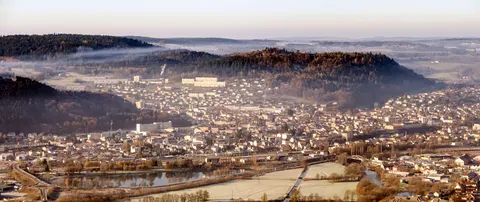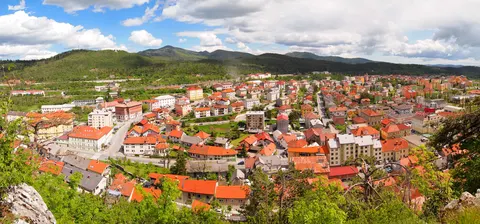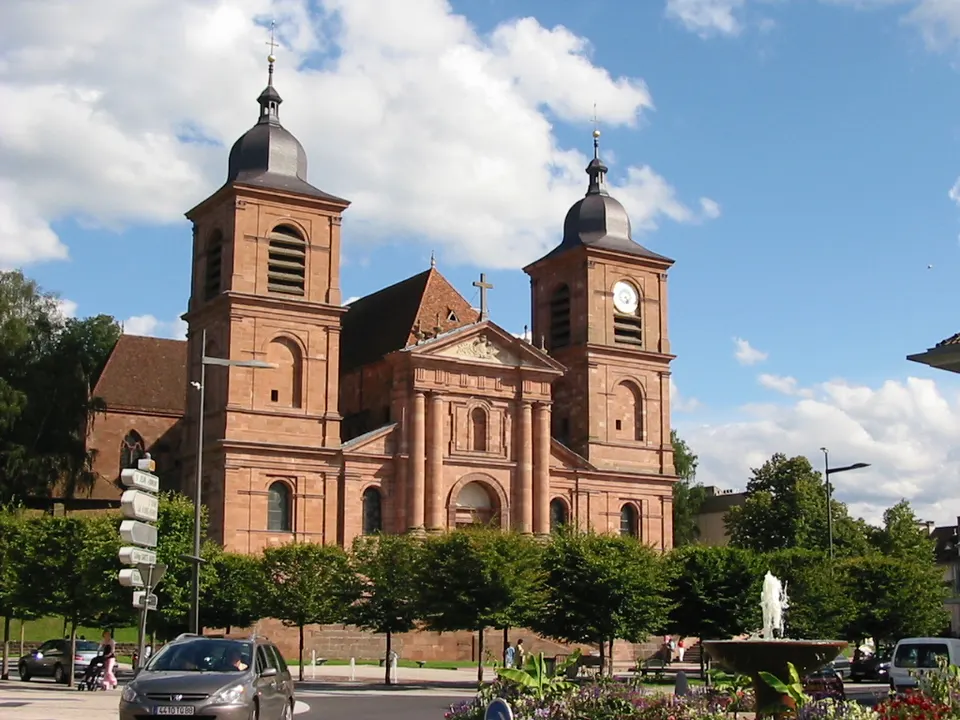

Saint-Dié-des-Vosges is a sub-prefecture in the Vosges department of northeastern France, set in the Vosges Mountains. It lies in the valley of the river Meurthe, roughly equidistant between Nancy and Strasbourg. The town grew up around a religious settlement linked to Saint Deodat, after whom it is named, and it remains the principal town of its arrondissement.
With about 25,000 inhabitants, Saint-Dié-des-Vosges lies in Grand Est, France, and is a rail hub.
Why go to Saint-Dié-des-Vosges?
Saint-Dié is a mountain town where the religious past is still visible. The Reformed Church holds six stained-glass windows by the Swiss artist Annie Vallotton, showing the first six days of Creation, and her brother was the minister there. At the foot of the Kemberg mountain, the old Saint-Dié chapel, locally called Saint-Martin, stands near the site of an earlier monastery. The town walls were built in 1290 by the canons and the dukes of Lorraine, who later became rivals for power here. The station connects the town by rail to Épinal, Strasbourg, Nancy and Paris.
When is the best time to visit Saint-Dié-des-Vosges?
Average highs range from 4 °C in January and December to 23 °C in July and August. May, June and September are the time for nature and hiking trips. May, June and September are the time for city breaks.
How do I get to Saint-Dié-des-Vosges without flying?
Direct train services link Saint-Dié-des-Vosges with 2 destinations. Allowing for changes, 2,253 destinations are no more than 14 hours away without flying. Nancy is 55 min away by train with SNCF VOYAGEURS, with about 0.2 kg of CO₂ per person. The train from Mutzig with SNCF VOYAGEURS takes 1h 03m; that is about 0.1 kg of CO₂ per person.
What to do in Saint-Dié-des-Vosges
Reformed Church
Six stained-glass windows by the Swiss artist Annie Vallotton show the first six days of Creation.
Chapel of Saint-Martin
The old Saint-Dié chapel at the foot of Kemberg mountain, close to the site of an early monastery.
Town walls
Built in 1290 by the canons and the dukes of Lorraine, who later became rivals for authority over the town.