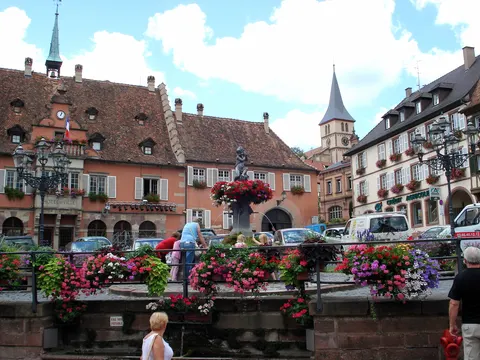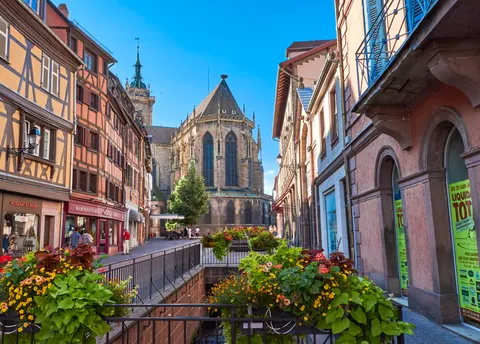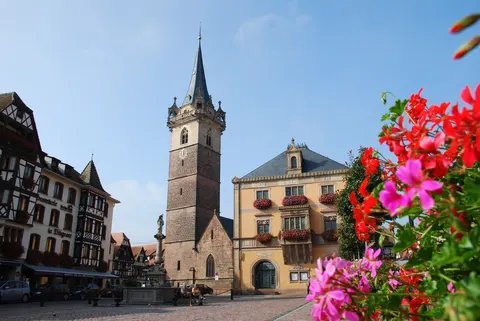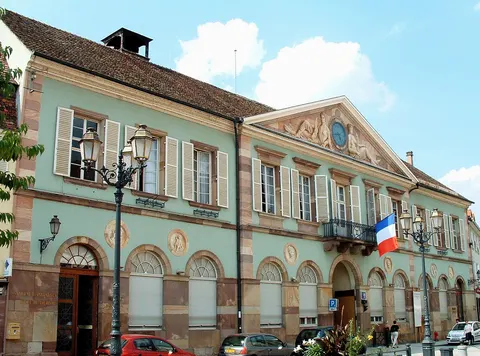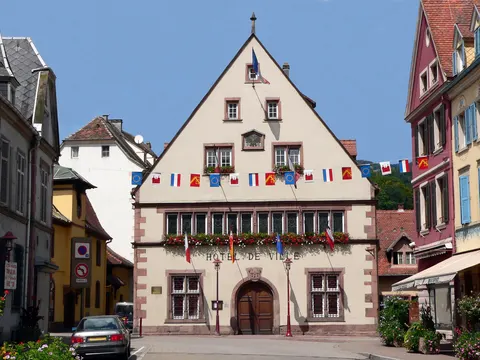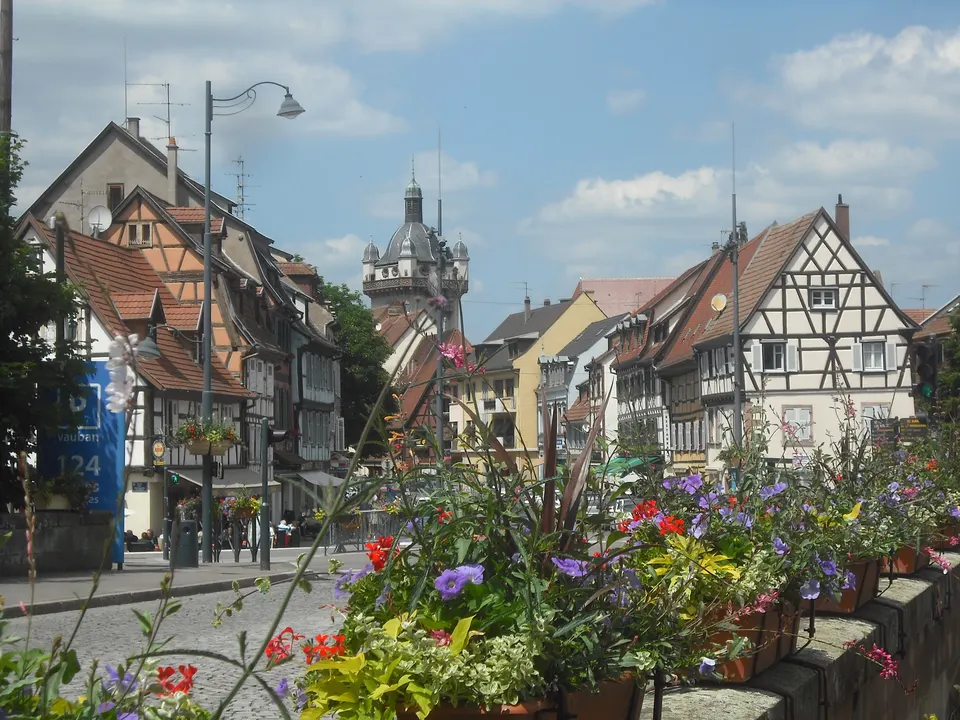

Sélestat is a town in the Grand Est region of France, in the centre of Alsace on the Ill river, about 17 kilometres from the Rhine and the German border. Its old town blends French and German heritage and has many medieval and Renaissance buildings. During the Renaissance it was a noted centre of humanism. Today it is a regional industrial centre and commercial hub, and its well-preserved old town draws visitors through its architecture and its library.
About 19,000 people live in Sélestat, in Grand Est, France, and its station is a rail hub.
Why go to Sélestat?
The main draw is the Humanist Library, which holds one of the oldest and most homogeneous collections of medieval and Renaissance works in Europe. Its core is the library of Beatus Rhenanus, and it was inscribed by UNESCO in its Memory of the World Register. Its displays include an 8th-century lectionary and a copy of the Cosmographiae Introductio, where the oldest mention of America can be found. The town's churches add to the visit. St. Faith's Church is a prime example of Romanesque architecture, and St. George's Church, a Gothic building, has a choir lit by 288 stained glass panels. The old town also has the quai des Tanneurs, one of the most picturesque streets in Alsace.
When is the best time to visit Sélestat?
Expect daytime highs of about 25 °C in July and August, falling to 5 °C in January. For city breaks, any month of the year works.
How do I get to Sélestat without flying?
You can get to Sélestat without changing from 4 destinations, by train. With changes, Sélestat is within 14 hours of 2,493 destinations without flying. From Strasbourg, it takes 18 min by train with SNCF VOYAGEURS, with about 0.1 kg of CO₂ per person. Travelling from Colmar, allow 10 min by train with SNCF VOYAGEURS; that is about 0.1 kg of CO₂ per person. Barr is 17 min away by train with Société Nationale des Chemins de fer Français, with about 0 kg of CO₂ per person.
What to do in Sélestat
Humanist Library
It holds the library of Beatus Rhenanus, with medieval manuscripts and Renaissance books, and it is open to both researchers and tourists.
St. George's Church
A Gothic church and the main parish church, often called the cathedral because of its size, though it has never been a diocesan seat.
St. Faith's Church
The oldest of the town's large medieval churches, built in the second half of the 12th century and a prime example of Romanesque architecture.
Tour des Sorcières
The tallest of the medieval towers that survive from the city walls. It served as a gate and a jail.
Quai des Tanneurs
A street lined with medieval tanners' houses, where a stream once ran down the middle for the trade.