By Thomas AxelssonPublished Updated 4 min read
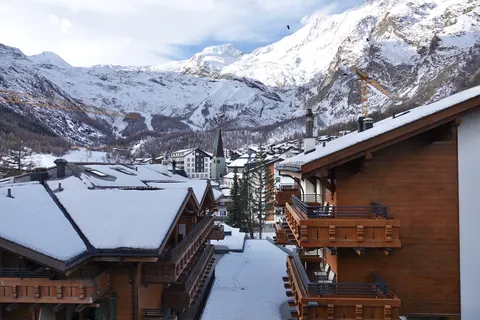
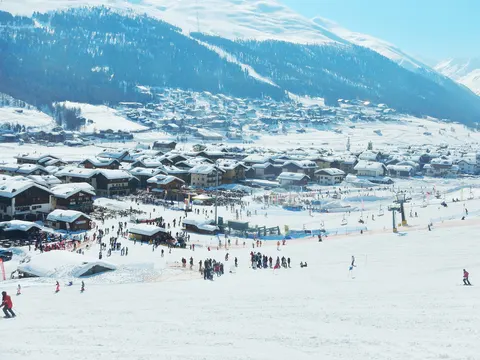
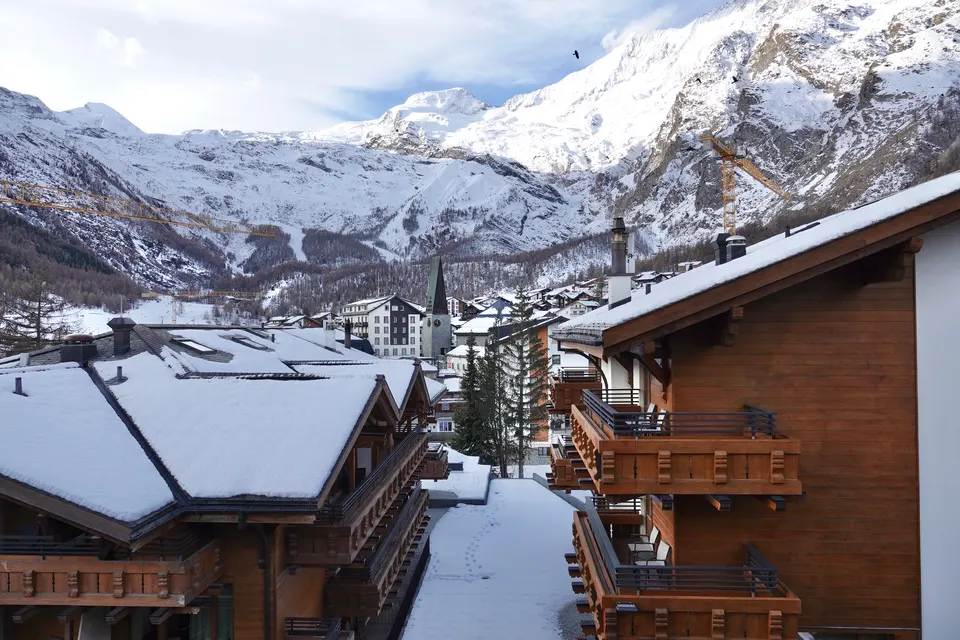
March still counts as ski season: 373 destinations have an average high in the snow and ski band. This post looks at eight of them, where highs run from -1 °C at Feichten im Kaunertal and Kühtai to 1 °C at St. Moritz and Montgenèvre, and shows which can be reached by train.
Where can you go for ski trips by train in March?
Not every route to the snow starts on rails, so the table names the mode of each leg alongside its March high.
| Destination | March high | a leg from here |
|---|---|---|
| Saas-Fee, Switzerland | 0 °C | bus to Visp, 29 minutes |
| St. Moritz, Switzerland | 1 °C | train to Chur, 1h 57m |
| Feichten im Kaunertal, Austria | -1 °C | bus to Landeck, 1h 00m |
| Livigno, Italy | 0 °C | bus to Bormio, 1h 15m |
| Kühtai, Austria | -1 °C | bus to Oetz, 42 minutes |
| Štrbské Pleso, Slovakia | 0 °C | train to Vysoké Tatry, 30 minutes |
| Speikboden, Italy | 0 °C | bus to Brunico, 18 minutes |
| Montgenèvre, France | 1 °C | bus to Briançon, 13 minutes |
Two places stand apart in this list. Štrbské Pleso is linked by train only, with a single direct link to Vysoké Tatry. St. Moritz is the rail hub of the group, with ten direct links by bus and train, including the Rhätische Bahn to Chur in 1h 57m and to Tirano in 2h 04m. The other six destinations rely on buses, and several of them have very few links: Saas-Fee and Kühtai have just one each, Feichten im Kaunertal, Speikboden and Montgenèvre two, and Livigno seven.
What is the weather like in March?
Cold, with a few degrees of difference between peaks. March is the peak month for snow and ski at Feichten im Kaunertal and Kühtai, while the other six peak in February. The March highs sit close together: -1 °C at Feichten im Kaunertal and Kühtai, 0 °C at Saas-Fee, Livigno, Štrbské Pleso and Speikboden, and 1 °C at St. Moritz and Montgenèvre.
Winter bites hardest earlier on. January is the coldest month at every destination here, and Feichten im Kaunertal gets down to -7 °C, Kühtai to -6 °C and Saas-Fee, St. Moritz, Livigno and Speikboden to -5 °C. By summer each destination warms up to between 14 °C and 19 °C in July or August, with Montgenèvre the warmest at 19 °C and Kühtai the coolest at 14 °C. For snow and ski trips, the strong months are January, February, March, April, November and December.
Which of these places is easiest to reach by train?
St. Moritz, the rail hub of the group. The train to Chur takes 1h 57m and the train to Tirano takes 2h 04m, while a bus runs to Livigno in 1h 30m. From this base you can reach 593 destinations within eight hours and 2,144 within fourteen.
Štrbské Pleso is the other train option, but it is the quietest base on reach: 297 destinations within eight hours and 1,009 within fourteen, the lowest counts of the eight on both. Its only link is the 30-minute train to Vysoké Tatry, so a trip there is short hops on one line rather than a wide choice of onward routes.
Bus-only places can still reach far. Montgenèvre covers 623 destinations within eight hours, the highest eight-hour count of the eight, and Saas-Fee follows with 612. Feichten im Kaunertal reaches 2,253 within fourteen hours, the highest fourteen-hour count. Livigno and Kühtai are on the lower side, with 305 and 317 within eight hours. Kühtai's only link is the 42-minute bus to Oetz, so a trip there starts from a very small network. Check that leg before you commit.
From St. Moritz, the first moves onward can stay on rail, to Chur or to Tirano. At the bus-only destinations, every onward step depends on a bus.
How much CO₂ does going by train save?
Sustainate's data has no flight to compare for these legs, so the figures below are the footprint of each ride on its own, not a saving. They are small either way.
The train legs are the lightest. St. Moritz to Chur emits 0.1 kg of CO₂ over 46 km, St. Moritz to Tirano 0.3 kg over 40 km, and Štrbské Pleso to Vysoké Tatry 0.1 kg over 13 km.
Buses weigh a little more. Feichten im Kaunertal to Landeck emits 0.9 kg over 32 km, the highest figure in this post, and Livigno to Tirano emits 1 kg over 36 km. Saas-Fee to Visp emits 0.6 kg over 21 km, and Kühtai to Oetz 0.3 kg over 9 km. These are per-leg figures, so add them up if your trip has more than one change.
What else is worth knowing before you go?
Several bus-linked destinations sit close together. Montgenèvre is 13 minutes by bus from Briançon and 25 minutes from Sauze d'Oulx. Livigno is 1h 15m from Bormio, 1h 30m from Tirano and 1h 30m from St. Moritz. Feichten im Kaunertal is 1h 36m from Serfaus.
Speikboden is 18 minutes by bus from Brunico and has two direct links in total, the other a 7-minute bus to Valle Aurina - Ahrntal. Saas-Fee has a single direct link, the 29-minute bus to Visp, so everything there hangs on one onward leg.
Most of these stays are about short transfers rather than long rides, so the real planning question is which valley you start from. Check the times for your date before you travel, and allow time at any change, since a short connection is easy to miss on a day when trains run late. These figures come from Sustainate's route data and may differ from the live timetable on the day.