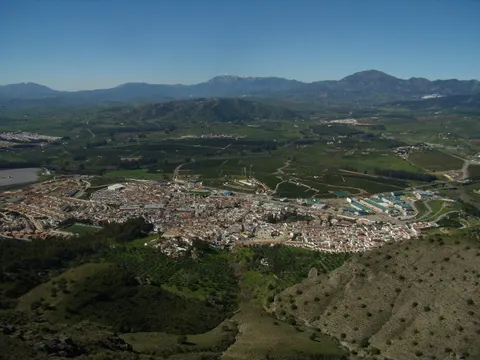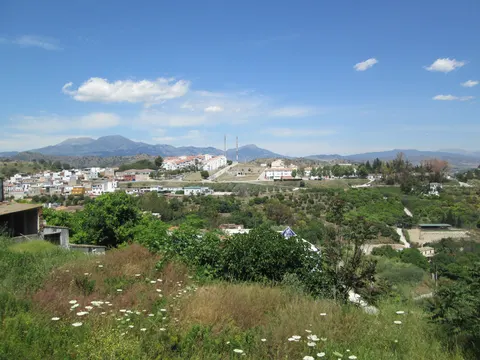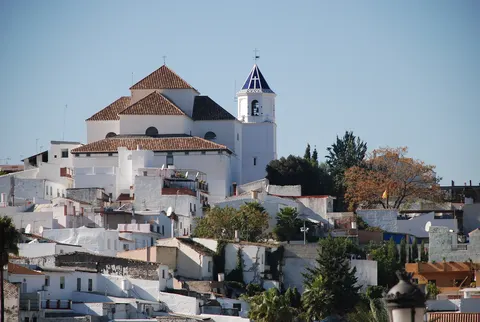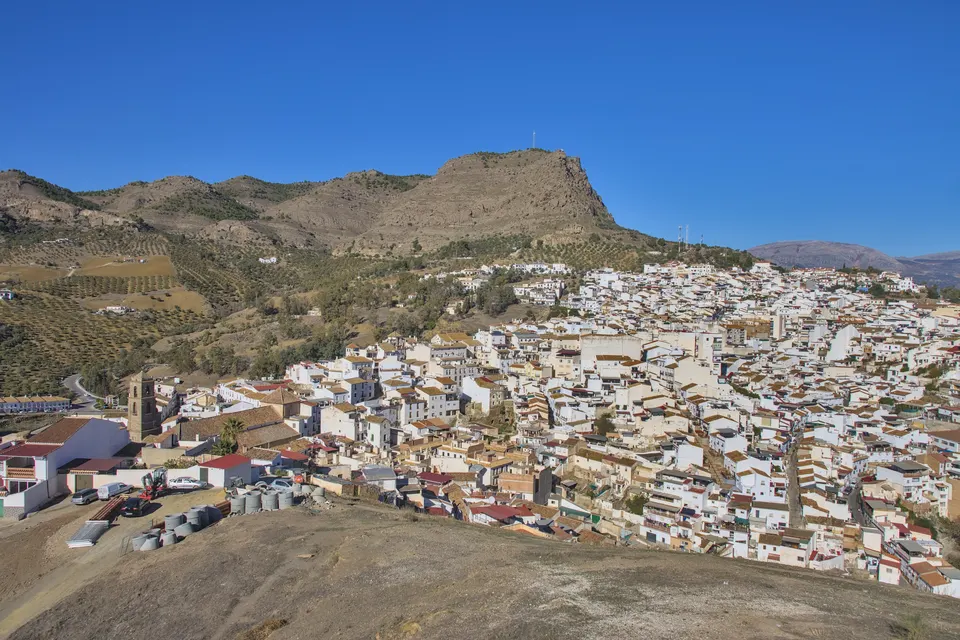

Álora sits on the right bank of the Guadalhorce river in the Valle del Guadalhorce, about 40 km from Málaga. It is a whitewashed pueblo blanco, a village wedged between three rocky spurs and crowned by the ruins of its castle. The municipality runs from cereal fields, olive groves and oak woods on the hills down to orchards on the valley floor.
About 13,000 people live in Alora, in Andalusia, Spain, and its station is a rail hub.
Why go to Alora?
Álora's story starts in prehistoric times at the Hoyo del Conde, a little over a kilometre from the town, and its castle carries layers from the Phoenicians, the Romans and the Moors. The Moorish mirador and the decorative steel door still survive from the later rebuild. Beyond the town lies the gorge of the Desfiladero de los Gaitanes, north of El Chorro, where the Caminito del Rey runs; it takes its name from King Alfonso XIII, who inaugurated it. To the west the Sierra de Aguas rises over pine forests, and the Córdoba-Málaga railway runs through the valley. Several 16th-century churches date from the town's prosperous period, when it flourished through the 16th and 17th centuries.
When is the best time to visit Alora?
Expect daytime highs of about 31 °C in July and August, falling to 14 °C in January.
How do I get to Alora without flying?
You can get to Alora without changing from 3 destinations, by train. With changes, Alora is within 14 hours of 370 destinations without flying. From Seville, it takes 2h 35m by train with RENFE OPERADORA, with about 1.2 kg of CO₂ per person. Travelling from Malaga, allow 35 min by train with RENFE OPERADORA; that is about 0.3 kg of CO₂ per person. Pizarra is 5 min away by train with RENFE OPERADORA, with about 0.1 kg of CO₂ per person.
What to do in Alora
Castillo de Álora
A castle in Alora.
Travel on from Alora
Direct links run to Seville, Malaga and Pizarra.
Compare the trip with flying
The trip planner compares train, bus and ferry options to Alora with a flight, including CO₂.