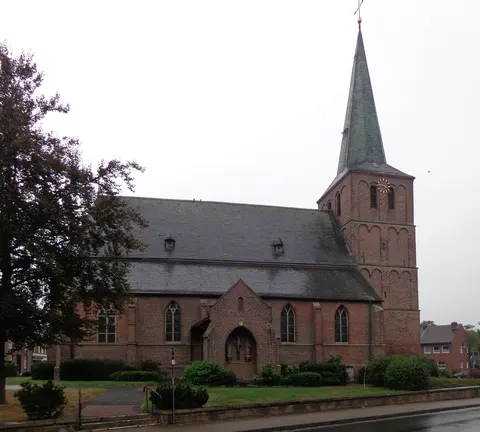
Alpen is a municipality on the Lower Rhine in the north-west of North Rhine-Westphalia, Germany. It lies in the Wesel district and is part of the Euregio Rhine-Waal, a cross-border association. Early medieval graves at Rill show that people settled here long before the place was first documented as a town in the early fourteenth century.
Alpen, in North Rhine-Westphalia, Germany, is home to about 13,000 people and works as a rail hub.
Why go to Alpen?
Alpen is a place for history. In the fourteenth century a local lord granted the town privileges and the right to mint coins. The town's Jewish community ran a synagogue from the early nineteenth century until it was destroyed in 1938, and the cemetery still holds 56 gravestones from the late eighteenth century to the 1930s. The Evangelical church is the oldest reformed parish church in Germany.
When is the best time to visit Alpen?
In July the average high reaches 23 °C; in January and December it is closer to 5 °C.
How do I get to Alpen without flying?
Alpen has direct train links to 2 destinations. Within 14 hours, travellers from 2,291 destinations can get here without flying. The train from Xanten with RheinRuhrBahn takes 9 min; that is about 0.2 kg of CO₂ per person. Duisburg is 35 min away by train with RheinRuhrBahn, with about 0.4 kg of CO₂ per person.
What to do in Alpen
Evangelische Kirche
The oldest reformed parish church in Germany, which makes it worth a visit in its own right.
Jüdischer Friedhof
A Jewish cemetery with 56 surviving gravestones, dating from the late eighteenth century to the 1930s.
Gräberfeld von Rill
An early medieval burial ground and the most important find of that period in the Alpen area.