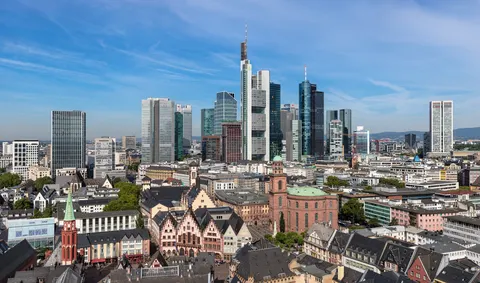
Aschaffenburg is a town in northwest Bavaria, Germany, on the westernmost edge of Lower Franconia. The Spessart hills separate it from the rest of the region, and the land opens west toward the Rhine-Main plain, so its inhabitants speak a local form of Rhine Franconian. The town belonged to the Archbishopric of Mainz for more than 800 years.
About 69,000 people live in Aschaffenburg, in Bavaria, Germany, and its station is a rail hub.
Why go to Aschaffenburg?
Aschaffenburg has a long church history. Its collegiate church of St. Peter and Alexander holds monuments by the Vischer family and a painting by Matthias Grünewald. The Schloss Johannisburg, built by an archbishop of Mainz, houses a library with a number of incunabula and a collection of engravings and paintings. Across the river lie the Park and the Schloss Schönbusch, while the Pompejanum is a replica of a Roman town house found in Pompeii. The historic old town and its museums, among them the Stiftsmuseum, round out a visit.
When is the best time to visit Aschaffenburg?
Expect daytime highs of about 24 °C in July and August, falling to 4 °C in January and December. If you are after city breaks, aim for May, June and September.
How do I get to Aschaffenburg without flying?
You can get to Aschaffenburg without changing from 5 destinations, by bus or train. With changes, Aschaffenburg is within 14 hours of 2,509 destinations without flying. From Munich, it takes 4h 26m by bus with FlixBus-eu, with about 7.3 kg of CO₂ per person against 62 kg for the flight, 88% less. Travelling from Frankfurt, allow 27 min by train with DB Fernverkehr AG; that is about 0.6 kg of CO₂ per person. Wurzburg is 37 min away by train with DB Fernverkehr AG, with about 1.1 kg of CO₂ per person.
What to do in Aschaffenburg
Schloss Johannisburg
Built by Archbishop Johann Schweikhard von Kronberg, the palace contains a library with a number of incunabula and a collection of engravings and paintings.
Pompejanum
A replica of a Roman town house discovered in Pompeii, commissioned by King Ludwig I and opened in 1850.
St. Peter und Alexander collegiate church
A church founded in the 10th century, which preserves monuments by the Vischers, a sarcophagus with relics of Saint Margaret and a painting by Matthias Grünewald.
Find tours and tickets: St. Peter und Alexander collegiate church
Schloss Schönbusch
A palace with its park, lying across the river from the town and one of the main sights of the area.
Old Town Cemetery
The Altstadtfriedhof holds the graves of the brothers Clemens and Christian Brentano and that of Wilhelm Heinse.