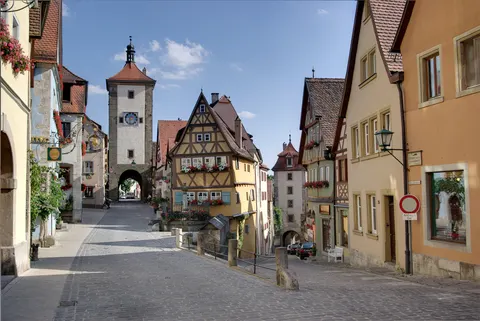
Würzburg is the second-largest city in Franconia, on the banks of the Main in the north of Bavaria. It is the administrative seat of Lower Franconia, and its old town is partly rebuilt and partly reconstructed after wartime damage. The Main flows through the city from southeast to northwest, and hills surround the centre, with the Marienberg rising to the west.
Wurzburg, in Bavaria, Germany, is home to about 134,000 people and works as a rail hub.
Why go to Wurzburg?
Most visitors come for the Würzburger Residenz, a Baroque palace that is a UNESCO World Heritage Site. Balthasar Neumann designed its famous staircase, and the vault above it holds a fresco by Giovanni Battista Tiepolo that is the largest of its kind in the world. The Hofkirche inside is richly decorated, and the Kaisersaal, the palace's central hall, recalls the city's ties to the Holy Roman Empire. To the west, the Festung Marienberg overlooks the whole town from its hill, and the chapel's foundations go back to the 8th century. The Alte Mainbrücke, lined with large statues of saints and historical figures, completes a walk through the old town.
When is the best time to visit Wurzburg?
In July and August the average high reaches 24 °C; in January it is closer to 3 °C. For city breaks, go in May, June and September.
How do I get to Wurzburg without flying?
Wurzburg has direct bus or train links to 19 destinations. Within 14 hours, travellers from 2,544 destinations can get here without flying. The train from Munich with DB Fernverkehr AG takes 2h 19m; that is about 3.8 kg of CO₂ per person, 92% less than the 50 kg of a flight. Cologne is 3h 21m away by train with ÖBB, with about 4.3 kg of CO₂ per person against 57 kg for the flight, 92% less. Travelling from Frankfurt, allow 1h 25m by bus with FlixBus-eu; that is about 2.6 kg of CO₂ per person.
What to do in Wurzburg
Würzburger Residenz
A Baroque palace commissioned by two prince-bishops and rebuilt after bombing in the Second World War. Its staircase by Balthasar Neumann is the highlight.
Festung Marienberg
A fortress on the hill west of the centre, overlooking the town and the surrounding hills. Most of its buildings date from the Renaissance and Baroque periods.
Alte Mainbrücke
An old bridge over the Main, built over several decades in the late Middle Ages and adorned with statues of saints and historical figures.
Hofkirche
The palace church inside the Residenz, with paintings, sculptures and stucco ornaments, and altars painted by Giovanni Battista Tiepolo.